Green Air Duct Club · San Antonio Since 2009

Commercial HVAC Cleaning in San Antonio — Compliance-Ready Service

Commercial HVAC cleaning addresses systems residential equipment cannot reach, in buildings that cannot stop operating to accommodate the work.
A commercial air handler needs access-panel removal, specialized agitation tools, and negative air machines rated for far higher CFM than residential units. We’ve worked San Antonio’s restaurants, medical campuses, and office properties since 2009 — inside the access limits and schedule constraints specific to this city.
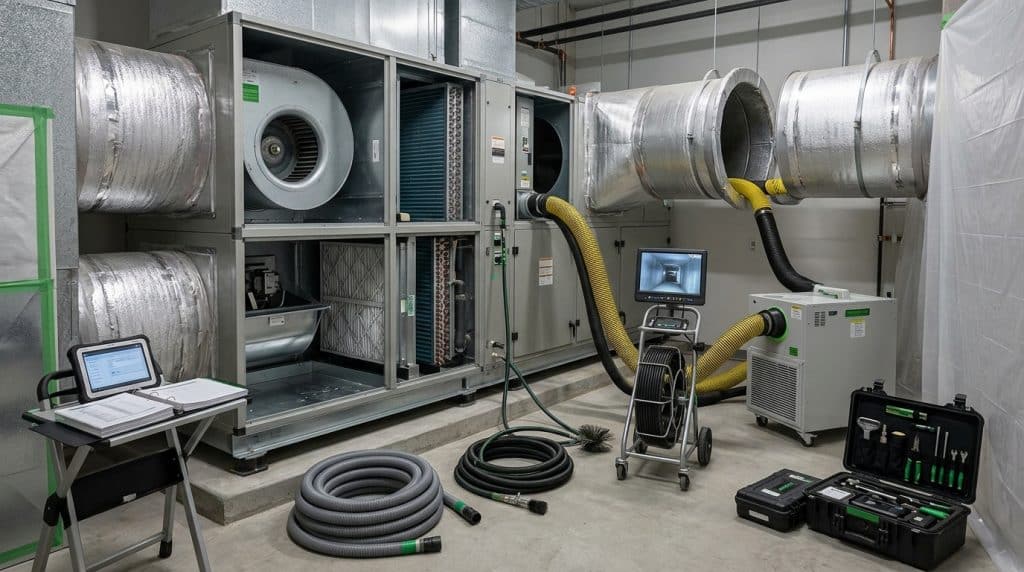
A professional HVAC testing facility displays large industrial air handling units with white circular fans mounted in metal enclosures on the left and right sides, connected by yellow and black flexible ducting to a portable dehumidification unit in the center. Various testing equipment including coiled flexible ducts, a laptop workstation, tablet monitor, and a black toolbox with green-handled tools are arranged on the concrete floor. The setup appears designed for performance testing, calibration, and maintenance of commercial ventilation and climate control systems.
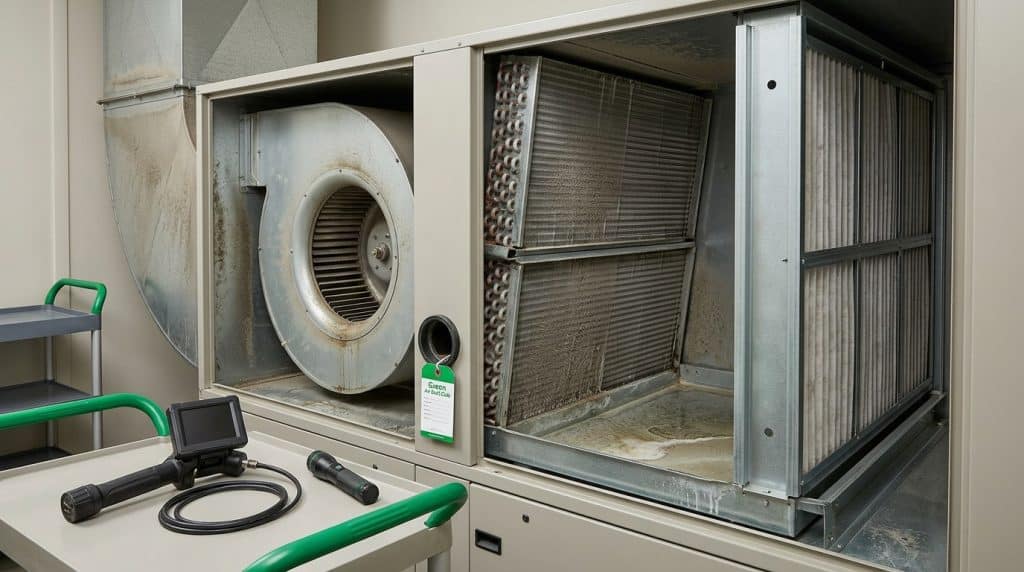
Industrial HVAC testing chamber with large circular fan unit on the left side and heat exchanger coils visible on the right, showing metal fins and louvers. A diagnostic thermal imaging camera and handheld testing equipment sit on the workbench in the foreground. The chamber features metal framework and inspection windows, used for evaluating air conditioning and ventilation system performance.
A Different Category

Why Commercial HVAC Systems Accumulate Contamination Faster Than Residential Ones

High occupancy, continuous operation, and facility-specific contamination push commercial systems toward service intervals residential timelines don’t reflect.
San Antonio’s hospitality sector — hotels, restaurants, and event venues around the River Walk and Convention Center — runs commercial kitchens where grease vapor travels through return-air pathways and deposits on duct surfaces, blower wheels, and air handler interiors. That’s a fire risk under health-code standards, not just a performance issue.
Medical facilities accumulate airborne particulate at a rate that reflects occupancy; MERV filtration helps, but the air handler interior still needs periodic direct cleaning. Multi-tenant office managers face a third situation entirely — no cleaning documentation for the current occupancy, sometimes no record of prior service at all. Each facility type needs a different protocol.
From The Field · Ori Tarzi, Founder

A Field Scenario from the Convention District
“A property manager near the convention district had one question when I arrived: when was this air handler last cleaned? The honest answer was that nobody knew. The previous tenant had operated a full kitchen for years, and the return-air system had pulled grease vapor across every cooling cycle that whole time.
What most facility managers don’t realize: the contamination isn’t limited to what you see at the access panel. Grease-laden deposits accumulate on the blower wheel, on the coil fins, and inside the drain pan — components that need the panel off and the right tools to reach. We traced the full system before scoping any work and found a blower wheel coated in hardened grease, coil fins partially blocked, and a drain pan generating its own odor.
We cleaned it over two nights — the restaurant stayed open for lunch and dinner both days. The manager received a written post-cleaning verification record documenting every component serviced, and it went into their compliance file. When the health department came through the following month, the documentation was there. That’s what commercial HVAC cleaning in San Antonio should look like.”
Ori Tarzi
Founder, Green Air Duct Club
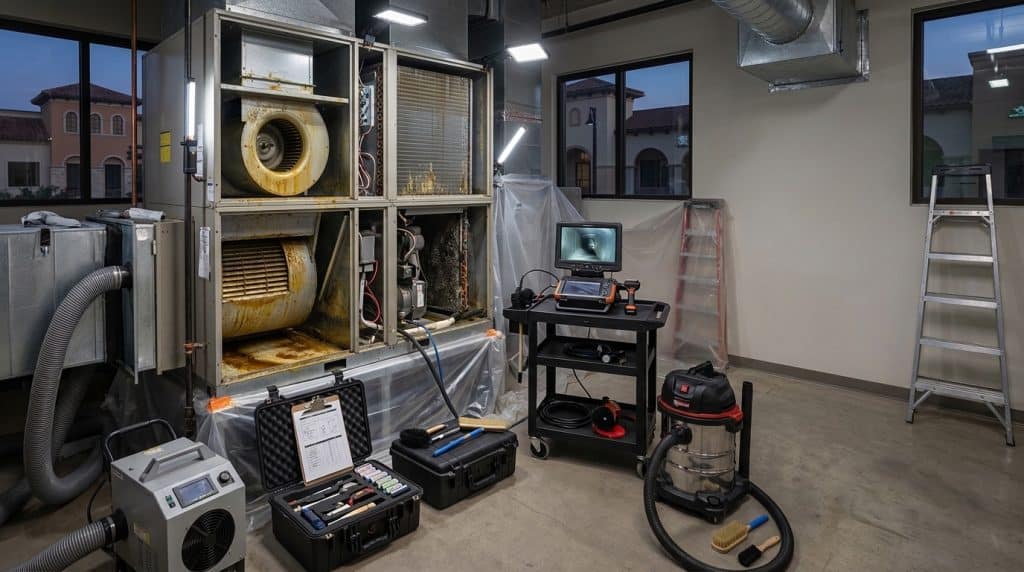
A professional testing and inspection laboratory features large industrial equipment including dual blower units mounted in metal frames, diagnostic instruments in carrying cases, monitoring devices on a workstation desk, and wet/dry vacuum equipment. The modern facility has polished concrete flooring, overhead ventilation systems, large windows overlooking an Italian-style courtyard, and a stepladder for equipment access. The setup appears designed for HVAC, air quality, or building system diagnostics and maintenance work.
On Your Schedule

Scheduling Around Your Facility — Not the Other Way Around

Night shifts, weekend windows, and phased zone access are standard operating practice — not exceptions that require special requests. Cleaning can be scheduled after close, on weekends between events, or phased by building zone so one section stays operational while another is serviced. We’re available 24/7 for commercial scheduling, and the access window you can offer is the one we build the job around — especially for restaurants that can’t lose a service and medical offices that can’t interrupt patient-facing hours.

How We Work

Our Commercial HVAC Cleaning Standards

Every commercial job begins with a system assessment — not an assumption about what the job covers.

Access-Panel Inspection First

The air handler is opened and inspected before any cleaning — so the scope is confirmed against what’s actually inside the unit.

Commercial-Scale Negative Air

Negative air machines sized to the system’s duct volume — not residential equipment applied to a commercial system.

Blower Wheel Cleaning

A standard component every time — the blower wheel is the primary distributor of whatever is present in the system.

Coil Cleaning

The evaporator surface is cleaned using agents appropriate to the contamination type present in the facility.

Drain Pan Service

Biological buildup removed and the condensate line confirmed clear before the job closes.

Verification Documentation

A written record of what was cleaned, what was found, and what equipment was used — formatted for property-management compliance files.

The Protocol

How Commercial HVAC Cleaning Gets Executed

From pre-job assessment to a compliance-ready verification record.
01

Pre-Job System Assessment

We identify the duct material type, air handler configuration, and available access points. Sheet metal plenums, fiberboard duct board, and spiral duct each require a different approach and determine how the negative air machine is positioned. This step also establishes which building zones can stay operational during the job.
02

Cleaning Implementation

The negative air machine creates source-removal pressure across the system. Agitation tools matched to the duct material loosen debris and grease so they travel to the collection unit rather than redistributing. The air handler is cleaned by component — coil, blower wheel, drain pan — and for grease infiltration, the return pathway is traced from the kitchen back to the air handler and cleaned along its full length.
03

Post-Cleaning Verification

We confirm system operation and document the scope in writing. The verification record includes the components serviced, equipment used, and pre- and post-cleaning condition of each major component — formatted for property-management files and suitable for inspection and insurance requirements.
Areas We Serve

Commercial HVAC Cleaning Throughout the Metro

We serve properties near the River Walk and Convention Center corridor, medical campuses and office buildings on the Northwest Side, multi-tenant office parks along US-281, and commercial facilities across Bexar County. After-hours and weekend scheduling is available at every location we serve.
Commercial Service Across Bexar County
Available 24/7

Schedule Your Commercial HVAC Cleaning in San Antonio

Post-cleaning documentation, after-hours access, and facility-type-specific protocols. Call to discuss your facility type, access window, and documentation requirements — we confirm the scope before the job starts and provide written verification when it’s done.
Prefer email? Reach us at gr*****************@***il.com. Available 24/7 across the metro.
Common Questions

Commercial HVAC Cleaning in San Antonio: FAQ

It involves larger air handlers, higher duct volumes, and contamination sources specific to the facility type — grease in restaurants, elevated particulate in medical environments, documentation gaps in multi-tenant offices. The equipment required, the protocols used, and the scheduling constraints are all meaningfully different from a residential job.
No. We schedule commercial jobs around your operating hours — nights, weekends, and phased building zones so operations continue while one section of the system is serviced. Restaurant operators can stay open for both lunch and dinner while work proceeds overnight.
Every commercial cleaning includes a written post-cleaning verification record identifying each component serviced, the equipment used, and the pre- and post-cleaning condition of major air handler parts. It’s formatted for property-management compliance files and suitable for health-department inspection or insurance review.
Intervals depend on facility type and occupancy. Restaurant and food-service systems typically need more frequent service because grease infiltration is continuous. Medical and office facilities generally follow annual or biennial schedules — though systems with no documented prior service should be assessed and cleaned regardless of elapsed time.
Restaurants, hotels, and event venues in the River Walk and Convention Center corridor; medical offices and outpatient facilities; multi-tenant office buildings; retail spaces; and other commercial properties throughout Bexar County. Any facility with a commercial air handler and a scheduling constraint is within our standard scope.
Yes. Many commercial properties we service have no documentation of prior cleaning — particularly buildings that have changed tenants or ownership. We begin every job with a system assessment that establishes current conditions regardless of history, and provide a written record afterward that becomes the baseline for future compliance.