
Green Air Duct Club · San Antonio Since 2009
Dryer Vent Cleaning in San Antonio — Fire Prevention, Not Optional
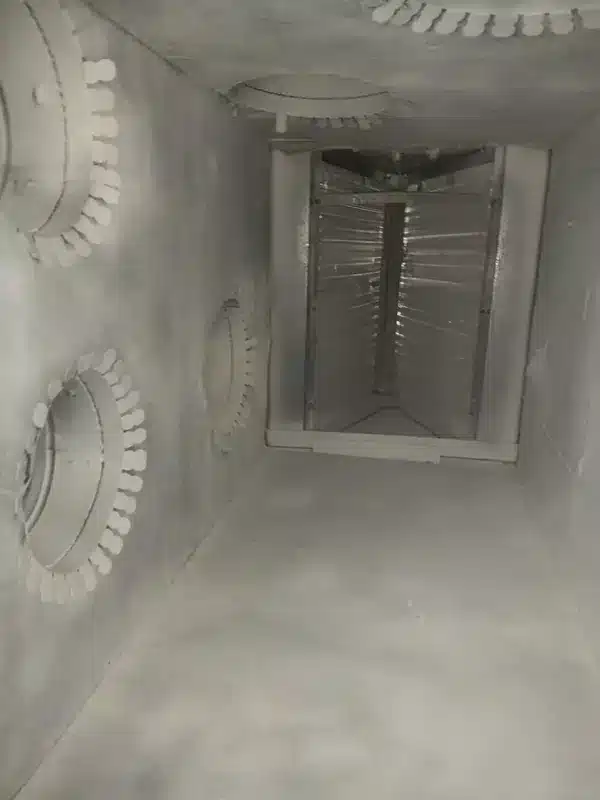
A dryer vent that hasn’t been cleaned accumulates lint throughout the entire duct run — not just near the machine.
The NFPA identifies failure to clean as the leading cause of home dryer fires in the U.S. Lint builds across the full path from the dryer’s exhaust collar to the exterior termination cap — so a vent cleaned only at the register face or the visible section near the dryer isn’t a cleaned vent. We clean the full run, collar to cap, and confirm airflow at both ends before the job is closed. Rated 4.8★ across 283 Google reviews.
- Full-Run: Collar to Cap
- Airflow Verified Both Ends
- 24/7 for Blocked Vents
Why It Builds Fast Here
What Dryer Vent Cleaning Looks Like in San Antonio Homes
Year-round laundry habits create dryer vent conditions that accumulate faster than most homeowners expect.
Homes here don’t get the seasonal laundry slowdown that prompts residents elsewhere to notice a sluggish dryer and schedule a cleaning. Families in Helotes, Converse, and the Pleasanton Road area run laundry continuously all year, so lint builds inside the run without interruption. And the longer the run, the faster it accumulates — pre-2000 ranch-style homes often place the laundry room far from an exterior wall, meaning longer duct runs, more bends, and more surface area for lint to collect.
Since 2009 we’ve worked the full range of vent configurations this housing stock produces — from short straight runs in newer townhomes near the urban core to long, multi-bend attic routes in ranch homes on the far northwest and northeast sides.
From The Field · Ori Tarzi, Founder
How to Read the Signs Your Dryer Vent Needs Cleaning
“The reactive call usually starts the same way: ‘My dryer keeps stopping in the middle of a cycle.’ That’s the thermal overload shutoff — the safety mechanism that cuts the dryer off when exhaust heat can’t escape. A blocked run traps that heat and the dryer shuts down to protect itself. Homeowners assume the machine is failing; the vent is the more common cause.
The second sign is drying time — a 45-minute load now taking over an hour, sometimes two cycles. That’s lint restricting airflow, and it adds up on the energy bill and wears the machine. The third is visible at the exterior cap: it should open freely when the dryer runs. We’ve pulled caps off homes where the exit was completely sealed with compacted lint.
A drying-time increase of 20 to 30 minutes per load is already in the range fire-safety organizations classify as elevated risk. If you’re running two full cycles for one load, that warrants a cleaning call.”
Ori Tarzi
Founder, Green Air Duct Club
Confirmed, Not Assumed
Full-Run Coverage — Confirmed Before the Job Is Closed
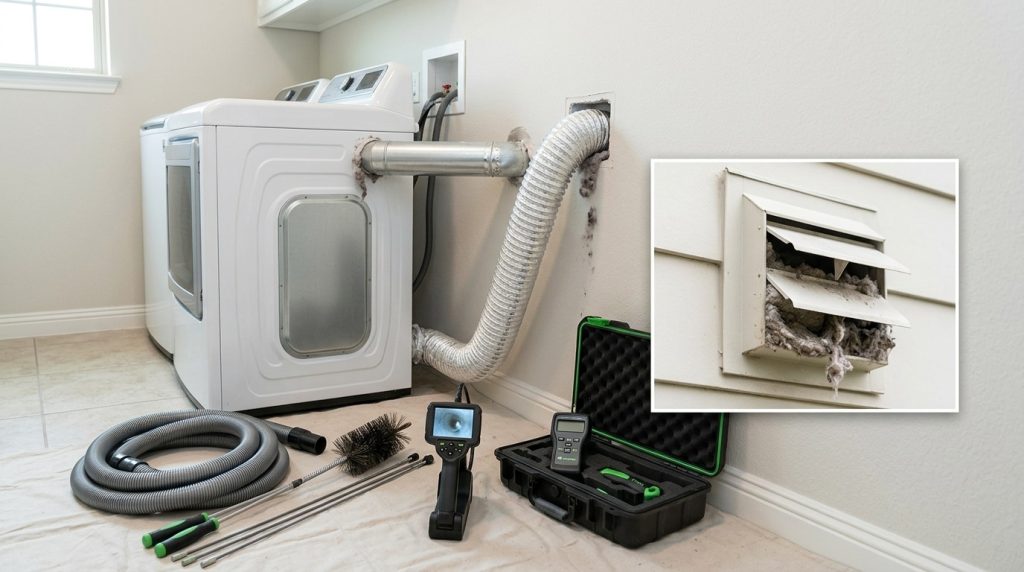
We clean from the dryer exhaust collar to the exterior termination cap — every section, every bend, and the cap itself, including the sections inside wall cavities or routed through the attic that aren’t visible from inside the home. Before closing, we verify airflow at the exterior termination: the cap damper must open under exhaust pressure and close when the dryer stops. If airflow at the cap isn’t confirmed, the job isn’t closed.
Every Job Covers
What Every Dryer Vent Cleaning Job Covers
Full run, verified airflow, exterior cap inspection — the same scope every time.
Full-Run Cleaning
We work from the dryer collar to the exterior cap — no partial clears that leave the middle of the run untouched.
Compacted Lint Removal
Rotary brush agitation breaks up compacted lint throughout the run, not just loose material near the openings.
Exterior Cap Inspection
We check the cap for blockage and damage and confirm the damper opens and closes freely under exhaust airflow.
Airflow Confirmation
Exhaust air must be exiting at the cap before the job closes — verified directly, not assumed.
Non-Compliant Material Flagged
If the run uses flexible vinyl or foil accordion duct, we identify it and explain your options — a separate repair, but you’ll know it’s there.
The Full Process
How We Clean a Dryer Vent in San Antonio
Diagnostics at the collar, full-run agitation, and verified airflow at the cap.
01
Diagnostics
We start at the dryer — the exhaust collar connection is inspected first, where disconnections and loose joints are most common. We note the duct material, number of bends, and total run length, and check the exterior cap condition if accessible. A run never cleaned, or not serviced in two-plus years, often shows visible compaction at the collar that continues through the full run.
02
Implementation
We use rotary brush equipment sized to the duct diameter — typically 4 inches for residential vents — feeding from the dryer end toward the exterior, agitating lint compacted at bends and along the walls. For longer runs (over 15 feet or more than two 90-degree bends) we work the duct from both ends to ensure complete coverage.
03
Post-Service Verification
We confirm airflow at the exterior cap — the damper should open under exhaust pressure and close when the dryer stops — and document any damaged, missing, or obstructed cap. The dryer is reconnected and a brief run cycle confirms the system is moving air correctly before we leave.
Where We Clean
Dryer Vent Cleaning Across San Antonio — 24/7 for Blocked Vents
We answer calls from townhomes and condos near the urban core, single-family homes on the far northwest and northeast sides, and every neighborhood in between. If your dryer has already triggered a thermal overload shutoff and stopped mid-cycle, we’re available 24 hours a day, seven days a week — not only during business hours. Same-day scheduling is available based on current crew availability.
Residential Service Across Bexar County
- Urban Core
- Helotes
- Converse
- Pleasanton Road
- Far Northwest
- Far Northeast
- Stone Oak
- Alamo Ranch
- Townhomes & Condos
- Bexar County
Available 24/7
Schedule Dryer Vent Cleaning in San Antonio
The dryer vent run in your home gets cleaned from collar to cap, with airflow confirmed at both ends. Serving San Antonio since 2009 — 4.8★ across 283 Google reviews. We’re available 24/7 for routine appointments and for situations where a blocked vent has already caused your dryer to shut down — same-day scheduling based on current crew availability.
Prefer email? Reach us at greenairductclubusa@gmail.com. Available 24/7 across the metro.
Common Questions
Dryer Vent Cleaning in San Antonio: FAQ
Once per year is the standard for most households. Homes with longer runs, multiple occupants doing frequent laundry, or dryers located far from an exterior wall may need cleaning every six to nine months. After your first cleaning, we note your run length and lint volume to give you a recommendation specific to your home rather than a generic interval.
Yes. The NFPA’s data on home dryer fires consistently identifies failure to clean as the leading contributing factor. Lint is highly flammable, and when it accumulates inside a run reaching normal dryer operating temperatures, the risk is real and documentable. Cleaning the full run removes that fuel load from the duct path.
Extended drying time is one of the most consistent indicators of restricted airflow in the run. It doesn’t always mean a complete blockage — even partial lint at bends can reduce exhaust velocity enough to double drying time. A cleaning confirms whether the vent is the cause; if airflow at the cap is strong afterward and drying time doesn’t improve, the dryer itself may have a separate issue.
We clean rigid metal duct and semi-rigid aluminum duct — both code-compliant for dryer vents. If the run uses flexible vinyl or accordion foil duct, we identify it during the inspection. Those materials aren’t code-compliant for dryer applications and aren’t cleanable the same way; we’ll explain your options for replacement, which is a separate scope from the cleaning.
Most residential jobs take between 45 and 90 minutes. Longer runs, attic-routed paths, or vents not serviced in several years take more time. We don’t quote a fixed time without knowing your run configuration — but we don’t leave until airflow at the exterior cap is confirmed, regardless of how long it takes.
Yes. Roof-exit configurations are common where the laundry room sits toward the center of the floor plan. These runs tend to be longer with more bends than wall-exit configurations, so they accumulate lint faster and require more thorough cleaning. We work the duct from both ends on roof-exit runs to ensure full coverage.