
Green Air Duct Club · San Antonio Since 2009
Commercial Air Duct Cleaning in San Antonio — NADCA-Standard, Documented for Your Files
Commercial duct cleaning requires commercial-grade equipment, commercial access planning, and documentation property managers can actually use.
This isn’t a scaled-up residential service. Multi-tenant offices, medical suites, restaurants, and retail centers move far more air through sheet metal plenums, fiberboard duct board, and spiral runs above occupied space. We apply NADCA ACR source-removal methodology on every job, size negative air machines to your actual duct volume, and include post-cleaning verification as a standard deliverable — not an add-on. Rated 4.8★ across 283 Google reviews.
- Source-Removal Standard
- Documentation Included
- Night & Weekend Access
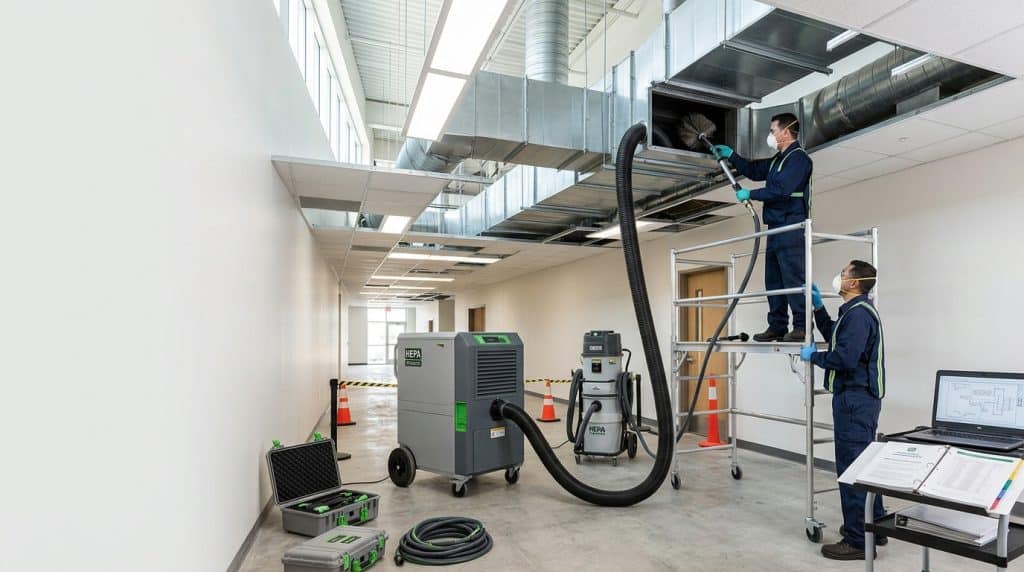
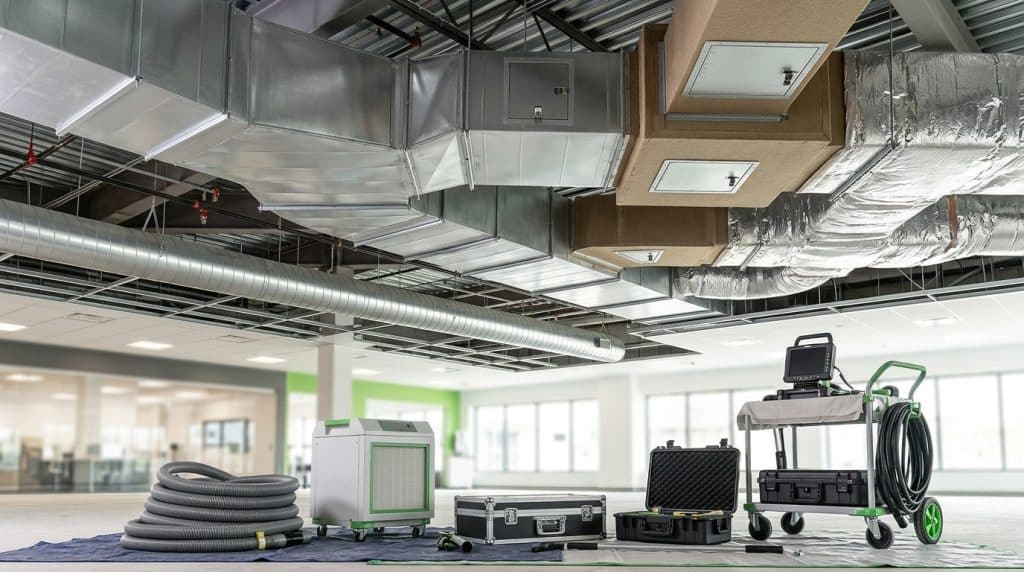
Equipment Matches Material
Why Commercial Duct Cleaning in San Antonio Demands Different Equipment
Every commercial building type brings a different duct configuration — and that configuration determines how the job is scoped.
Office buildings along US-281 and Loop 410 often contain fiberboard duct — compressed glass fibers with a foil-facing interior, common in 1970–2000 construction — whose porous interior accumulates contamination differently than sheet metal and needs specific protocols to avoid surface damage. Restaurants and retail in the convention district and Pearl area often use spiral duct; Medical Center suites route supply air through sheet metal plenums that require panel removal and specialized tools.
A cleaning approach that works on one material requires adjustment for another. Equipment and technique must match the material in the building — and we’ve worked all three across every commercial construction era in Bexar County since 2009.
From The Field · Ori Tarzi, Founder
From the Field: What a Large-System Job Actually Looks Like
“A four-story multi-tenant office off Loop 410 — two air handlers per floor. A new tenant was moving into the third floor, and the lease required documentation that the duct system had been cleaned during the current occupancy. When we pulled the first plenum panel, nothing had been serviced since the previous tenant: debris compacted inside the sheet metal at the bends and transitions, and moisture staining on the foil face of the east-side fiberboard.
That job needed a negative air machine rated for the CFM to maintain effective negative pressure across the whole floor’s duct volume. A residential unit moves air in one section while the rest stays unaffected — that’s not source-removal, that’s incomplete extraction. We worked zone by zone, each sealed off from the occupied floors before starting, cleaning the fiberboard with controlled agitation — not the brush methods for sheet metal.
The post-cleaning verification — scope, equipment used, areas serviced — was ready for the property manager the same day the job closed, and went straight into the tenant file. That’s the deliverable that protects the manager when a lease auditor asks what was done and when.”
Ori Tarzi
Founder, Green Air Duct Club
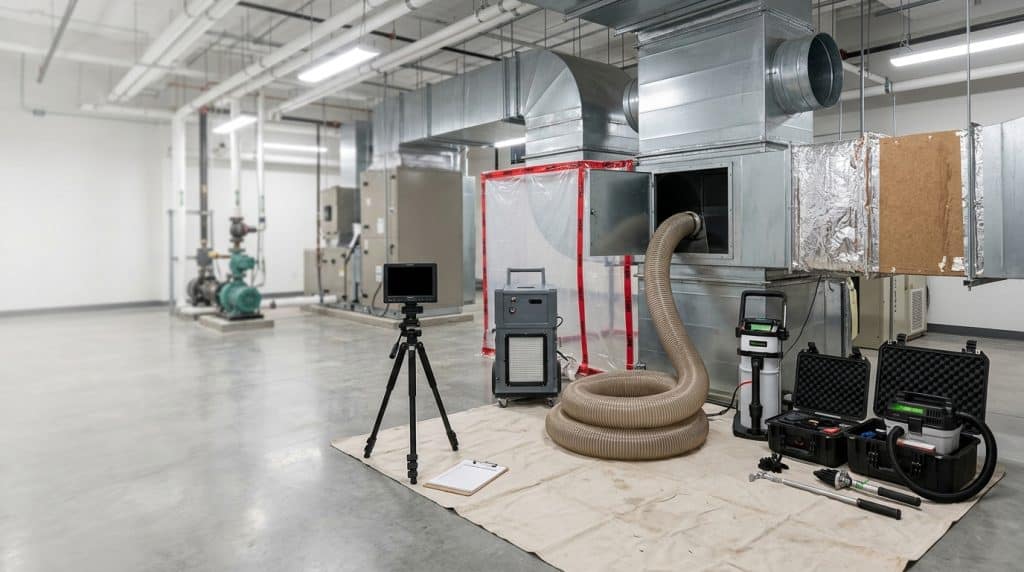
Why Documentation Matters
Post-Cleaning Documentation Comes Standard on Every Commercial Job
Post-cleaning verification is the record confirming what was cleaned, what equipment was used, and which areas were serviced. Some leases require it, some insurance policies reference it, most facility standards expect it — and when a new tenant moves in or an air-quality concern is raised, a property manager needs documentation, not a verbal assurance from a contractor who may no longer be reachable. We include the scope, equipment used, negative air machine CFM rating, and areas serviced, formatted to go directly into a tenant file. If no documentation exists for your building under current or previous occupancy, that gap is worth closing before a tenant asks.
Applied Every Job
Commercial Duct Cleaning Protocols We Apply on Every Job
Held to the same NADCA ACR source-removal standard — regardless of building size or duct material.
CFM-Sized Negative Air
Negative air machines are sized to the actual CFM requirement of the duct system being cleaned — not residential equipment on a commercial system.
Material-Matched Methodology
Sheet metal, fiberboard, and spiral duct each get distinct protocols — controlled agitation on fiberboard, seam-and-transition work on plenums.
Access Planning First
Plenum panels, mechanical room entries, and ceiling-tile access zones are identified before any equipment enters the building.
Zone Isolation
Every section is sealed before cleaning begins so loosened debris stays in the collection path, not the occupied space.
Verification Documentation
Scope, equipment, negative air CFM rating, and areas serviced — produced as a standard deliverable, formatted for facility files.
Execution Protocol
How a Commercial Duct Cleaning Project Runs
Pre-job access assessment, zone-by-zone cleaning, and post-cleaning verification.
01
Access Assessment & System Mapping
Before equipment enters, we locate every access point — plenum panels, mechanical entries, ceiling-tile zones above tenant spaces, existing service openings — confirm which materials are present in each zone, and size the negative air machine to the actual duct volume per floor. Scheduling is confirmed with property management, with evening and weekend windows for occupied buildings.
02
Zone-by-Zone Source-Removal
Work begins one zone at a time, each isolated before cleaning. The negative air machine creates negative pressure so loosened debris travels to the collection unit, not back into the space. Tools match the material: controlled agitation on fiberboard without breaching the foil, seam-and-transition work on sheet metal plenums, access-collar work on spiral runs.
03
Verification & Documentation
As each zone completes, airflow is verified at supply registers, the machine is removed, and collection units are sealed before leaving. The verification record — scope, equipment, CFM rating, areas serviced, completion date — is delivered to property management before the job closes.
Where We Serve
Commercial Duct Cleaning Across the San Antonio Metro
We serve multi-story office buildings, medical suites, restaurants, and retail centers — from the US-281 and Loop 410 business corridors to the Pearl District, Southtown, and the convention and tourist district — plus commercial properties throughout Bexar County, including Schertz, Converse, and Leon Valley. Scheduling is coordinated directly with property management around tenant occupancy and operating hours.
Commercial Properties Across Bexar County
- US-281 Corridor
- Loop 410
- Pearl District
- Southtown
- Convention District
- Medical Center
- Schertz
- Converse
- Leon Valley
- Bexar County
Available 24/7
Schedule Your Commercial Duct Cleaning in San Antonio
Describe your facility type, building size, and any documentation requirements, and we’ll confirm equipment sizing, access requirements, and a scheduling window that works around your operations. Post-cleaning verification comes standard.
Prefer email? Reach us at greenairductclubusa@gmail.com. Available 24/7 across the metro.
Common Questions
Commercial Air Duct Cleaning in San Antonio: FAQ
Commercial systems move significantly more air through larger assemblies — sheet metal plenums, fiberboard duct board, and spiral duct — that residential equipment can’t adequately pressurize. Commercial jobs also require access planning specific to occupied multi-tenant buildings and produce post-cleaning documentation residential jobs typically don’t.
It means loosened debris is captured under negative air pressure rather than redistributed through the ducts or exhausted into the occupied space. For a multi-tenant building, redistributing contamination during cleaning isn’t an acceptable outcome. Negative air machines sized to your system’s actual CFM requirement are what make source-removal work at commercial scale.
We coordinate directly with property management before any equipment enters. For occupied offices, restaurants, or medical suites, we work off-hours — evenings and weekends are standard. Zone-by-zone isolation lets us clean one floor or section while the rest of the building keeps operating.
The scope of work completed, the duct material types serviced, the negative air machine CFM rating used, the specific areas cleaned, and the completion date — formatted to go directly into a tenant file or facility management system, delivered before the job closes.
Yes. Sheet metal plenums, fiberboard duct board, and spiral duct each require distinct agitation and extraction protocols. Fiberboard in particular needs controlled agitation that doesn’t breach the foil-facing interior. Applying the wrong technique can damage the duct surface, so we identify materials during the pre-job access assessment and match the protocol accordingly.
NADCA guidelines recommend cleaning when contamination is confirmed or when a documented interval has passed based on facility type and occupancy. High-traffic facilities — restaurants, medical offices, buildings with recent renovation — accumulate faster than low-occupancy spaces. If no documentation exists for the current occupancy, that’s a reasonable starting point for scheduling an assessment.