
Green Air Duct Club · San Antonio Since 2009
Dryer Vent Repair in San Antonio — Crushed, Disconnected, or Wrong Material
Dryer vent repair addresses three specific failure types — crushed flexible duct, disconnected vent joints, and non-compliant material. None of them get resolved by cleaning alone.
Each one stops your dryer exhaust from reaching the outside, and each creates a different hazard inside the wall, cabinet, or attic where it fails. If your dryer takes two cycles to dry a load, runs hot to the touch, or shuts off mid-cycle, the vent line is worth inspecting. We identify which failure you’re dealing with before any repair begins — then fix that specific problem with the correct material.
- Failure Identified First
- Code-Compliant Rigid Metal
- 24/7 for Active Failures


Pre-2005 Housing
What We Find Inside Dryer Vent Systems in Homes Built Before 2005
San Antonio’s pre-2005 housing stock was built with dryer vent materials now either prohibited or strongly discouraged under current fire codes.
A large share of homes built between 1985 and 2005 used flexible vinyl or foil accordion duct — a dryer exhaust material with a ribbed interior — behind the dryer. It was available at hardware stores, easy to install, and code-compliant at the time. It isn’t now. The ribbed interior walls accumulate lint faster than smooth metal, and the material melts rather than containing a fire.
Foil accordion duct doesn’t fail all at once. It sags between support points, kinks when the dryer gets pushed too close to the wall, and the restriction builds gradually. In neighborhoods like the South Side and older sections of Alamo Ranch, we find the same pattern repeatedly — foil from the dryer, a few sharp bends through a cabinet, and a termination cap painted over twice. The system technically exists. It’s just not working.
From The Field · Ori Tarzi, Founder
Crushed, Disconnected, Wrong Material — Which Failure Do You Have?
“I’ve been inside a lot of San Antonio dryer vent lines over fifteen-plus years, and these three failure types aren’t theoretical — they show up on almost every repair call in some combination.
A crushed vent usually comes from the dryer shifting position over time. Flexible duct behind the dryer doesn’t hold its shape under repeated contact — it gets pushed flat, the airflow cross-section shrinks, lint backs up at the crush point, and heat has nowhere to go except into the wall or cabinet. A disconnected vent is a joint inside a wall, attic, or cabinet that has separated, releasing heat, moisture, and lint into the enclosed space. Attic disconnections are common in San Antonio roof-vented homes — long runs with joints secured by friction alone.
Wrong material — flexible vinyl or foil accordion run the full length — is the most common finding. It isn’t something breaking; it’s material that was never appropriate for the full run. The IRC now prohibits flexible vinyl entirely for dryer exhaust, and foil accordion is restricted to transition-duct use only — the short connector between dryer and wall, limited to 8 feet under IRC Section M1502. When it runs the full length, the fix is replacement. The old material comes out. Rigid metal goes in.”
Ori Tarzi
Founder, Green Air Duct Club
Full Replacement, Not A Patch
Rigid Metal Duct Installed to Current Code — Not a Patch on a Non-Compliant Line
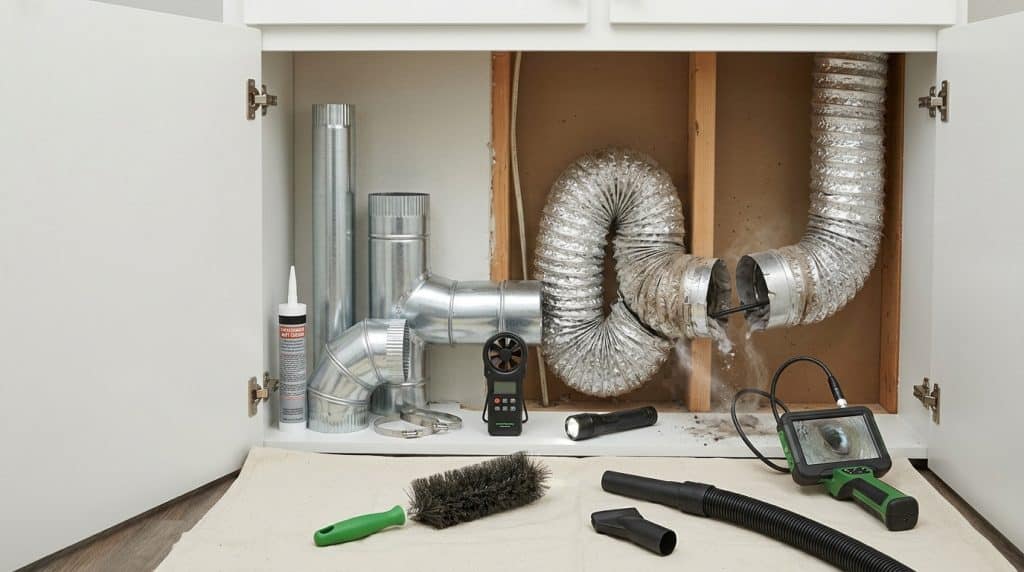
We replace non-compliant dryer duct material completely — we don’t seal over it or install rigid sections on top of a foil line that stays in the wall. Foil accordion left inside a wall cavity creates a risk a clean exterior section can’t address; if the material is wrong, it needs to come out. Homeowners sometimes ask about a partial repair — replacing only the accessible section while leaving foil routed through the wall. In most cases the answer is no: IRC Section M1502 requires the entire exhaust duct system to use approved material from the exhaust collar to the termination cap. A hybrid line — part rigid metal, part foil — doesn’t meet that standard. For homeowners who’ve had a dryer event or near-miss, insurance documentation may need to confirm the full system is compliant, not just the accessible section.
Every Repair Covers
What Every Dryer Vent Repair Covers — Materials, Routing, Code
Every repair uses rigid or semi-rigid metal duct from the dryer exhaust collar to the exterior termination cap.
UL 2158A Transition Duct
The short connector from dryer to wall must be UL 2158A listed and no longer than 8 feet under IRC M1502.
Smooth-Wall Rigid Duct
All rigid sections are smooth-wall galvanized or aluminum — no ribbed interior surfaces that trap lint.
Minimized, Sized Bends
Bends are kept to a minimum and sized to their equivalent duct length under IRC Section M1502 calculations.
Termination Cap Inspected
The exterior cap is replaced if it has a lint-trapping screen, the damper doesn’t seat, or it’s been painted over or sealed.
Heat-Rated Sealed Joints
All joints are secured with sheet metal screws and sealed with metal foil tape — not duct tape, which degrades under heat.
By Failure Type
How We Repair Each Failure: Crushed, Disconnected, Wrong Material
Diagnose the failure, repair to code, and confirm exhaust at the cap.
01
Diagnostics
We run the dryer and measure airflow at the exterior termination — a correctly flowing vent produces strong, continuous exhaust you can feel from several inches away. If it’s absent, restricted, or inconsistent, we trace the full run from collar to cap, including the portion inside the wall, attic, or cabinet chase. Crushed sections show as visible deformation; disconnections as heat and lint releasing into a space that should be sealed; wrong material by the duct type itself.
02
Implementation
Crushed sections are replaced with rigid metal and the routing is adjusted to eliminate what caused the crush. Disconnected joints are accessed, reconnected, fastened with screws, and sealed. Full material replacements begin at the dryer collar and run continuously to the exterior cap — no partial replacements that leave non-compliant material in the wall. We minimize bends, support all horizontal runs to prevent future sagging, and replace the transition section if it’s the wrong type or exceeds 8 feet.
03
Post-Service Testing
We run the dryer on a heat cycle and confirm exhaust at the exterior cap, check that the cap damper opens fully under airflow and closes when the dryer stops, and verify any exhaust-restriction error code has cleared before we leave. A repaired line shows itself: the dryer completes a normal timed cycle without cutting off, and the exterior exhaust is strong and unobstructed.
Where We Repair
Dryer Vent Repair Across San Antonio — 24/7 for Active Failures
We work established neighborhoods along the South Side corridor, newer construction in Alamo Ranch and Fair Oaks Ranch, and everything in between. If a disconnected vent is actively exhausting into a wall cavity or attic right now, that’s an urgent situation — and we’re available around the clock to address it across Bexar County.
Residential Service Across Bexar County
- South Side Corridor
- Alamo Ranch
- Fair Oaks Ranch
- Roof-Vented Homes
- Helotes
- Converse
- Stone Oak
- Northwest Side
- Urban Core
- Bexar County
Available 24/7
Schedule Dryer Vent Repair in San Antonio
A properly repaired dryer vent means your dryer finishes a normal load in one cycle, the exterior cap exhausts freely, and no heat or moisture builds inside your walls. Let us know what you’re seeing — how the dryer is behaving, when it started, and whether you know where the vent exits the house — and we’ll take it from there. Available 24/7.
Prefer email? Reach us at greenairductclubusa@gmail.com. Available 24/7 across the metro.
Common Questions
Dryer Vent Repair in San Antonio: FAQ
Cleaning removes lint from a duct line that is structurally intact. Repair addresses physical failures — crushed sections, separated joints, or duct material that doesn’t meet current code. If your vent is crushed or disconnected, cleaning it won’t restore airflow; the structural problem has to be fixed first.
A dirty vent produces slow drying and mild heat buildup. A crushed vent often causes the dryer to shut off mid-cycle due to thermal overload, because exhaust can’t escape at all. If cleaning doesn’t resolve slow drying, the duct run should be inspected for physical deformation or disconnection.
It depends on the failure type and material. A single disconnected joint in an otherwise rigid metal line can often be repaired in isolation. But if the run includes non-compliant foil or vinyl duct anywhere in its length, IRC Section M1502 requires the entire system to be replaced with approved material — not just the damaged portion.
All repair work uses smooth-wall rigid or semi-rigid galvanized or aluminum metal duct. The transition section directly behind the dryer is replaced with a UL 2158A listed flexible metal connector no longer than 8 feet. Foil accordion duct and vinyl duct are not reinstalled under any circumstances.
Yes, in most cases. A disconnected vent exhausts heat, moisture, and lint directly into whatever enclosed space surrounds it — a wall cavity, attic, or cabinet — creating fire risk and moisture damage simultaneously. We’re available 24 hours a day, seven days a week for active vent failures in San Antonio.
A single-point repair — one crushed section or one disconnected joint — typically takes one to two hours. A full material replacement on a longer run through a wall or attic can take two to four hours depending on access. We confirm airflow at the exterior cap before closing out every job.