
Green Air Duct Club · Resource · San Antonio
Professional Duct Cleaning vs. DIY in San Antonio — What the Difference Looks Like
The difference between DIY and professional duct cleaning comes down to one number: CFM.
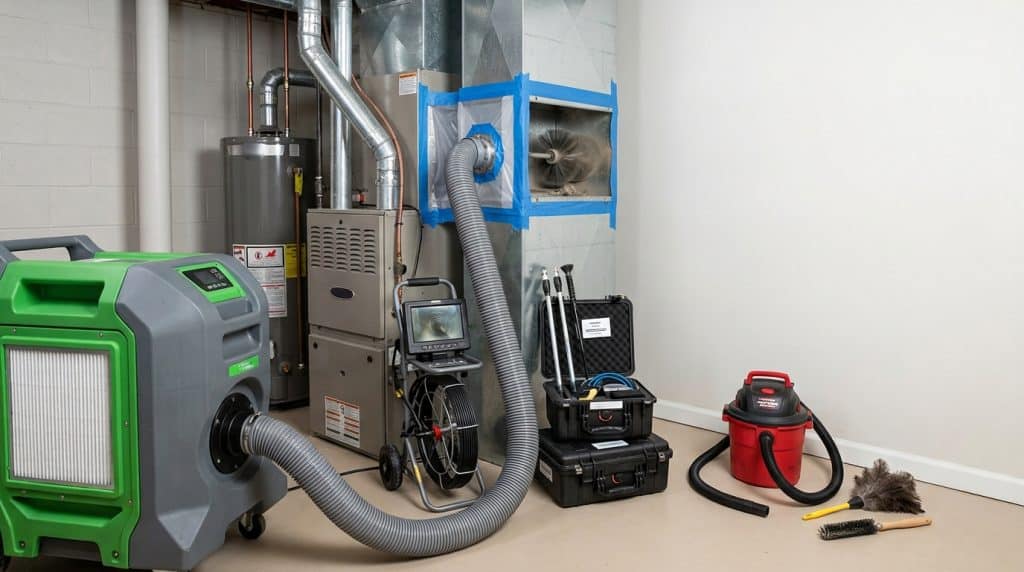
CFM — cubic feet per minute — measures how much airflow a vacuum or blower generates. A consumer shop vacuum produces roughly 100 to 200 CFM. A truck-mounted negative air unit, the kind we use on every job, generates 10,000 to 16,000 CFM. That gap isn’t a marketing claim — it’s physics, and it determines whether loosened debris moves toward a collection point or simply redistributes inside your ducts.
- 10,000–16,000 CFM Equipment
- Full Containment
- Source-Removal Method
The Honest Answer
The Question Is Reasonable — Here Is the Honest Answer
The CFM figure determines whether loosened debris moves toward a collection point or redistributes inside the duct system. Without enough sustained negative pressure — the kind that pulls across the full length of a run — agitated debris has nowhere to go except back into your air stream. A shop-vacuum wand inserted at a register face can clean the first few inches of duct; what sits ten or fifteen feet in, compacted against the inner liner wall, stays exactly where it is. That’s not a failure of effort — it’s a physical limit of the equipment.
Why It Matters Here
San Antonio Homes Make This Gap Matter More
Long duct runs and older systems turn the CFM gap from a technical detail into a practical one. In far northwest Bexar County, large single-story homes push runs thirty, forty, sometimes fifty feet from the air handler to the register — and the debris at the far end of a fifty-foot run isn’t reachable by any consumer tool inserted at the register face. In the urban core — Beacon Hill, Prospect Hill, downtown — original 1970s and 1980s duct is still in place, with decades of particulate on the inner liner walls that releases more material at once when agitated because the liner has stiffened over years of thermal cycling.
San Antonio’s extended cooling season compounds it: more operating hours mean more debris deposited per year, and the fine limestone particulate common across Bexar County enters return air intakes continuously, coating liner surfaces in ways consumer equipment can’t dislodge under adequate capture suction.
What Makes It Work
What Containment Protocol Looks Like During a Professional Job
Professional source-removal cleaning seals every register except the one being actively worked — and that step is what makes negative pressure effective. With all non-active registers sealed, loosened debris travels in one direction: toward the truck-mounted collection unit outside the home. Homeowners sometimes ask whether the process will push debris into the living space; with proper containment in place, the answer is no — the pressure differential runs from the duct interior toward the collection unit, not back through the supply registers. Containment isn’t optional. It’s the step that makes source-removal cleaning work as intended.
Every Job
Our Standards for Every Duct Cleaning Job
The same equipment and protocol on every residential duct cleaning in San Antonio, regardless of home size or system age.
Truck-Mounted Negative Air
10,000–16,000 CFM equipment on every job — no portable shop-vacuum substitutes that top out at 100–200 CFM.
Full Containment Protocol
All non-active registers sealed before work begins, so negative pressure concentrates where it’s needed.
Source-Removal Method
Debris is loosened and immediately captured — not agitated and left to resettle deeper in the system.
Inner-Liner Wall the Target
We work the accumulation ten-plus feet in, not just the accessible section near the register face.
Post-Cleaning Airflow Check
We confirm the system is moving air freely after cleaning — and if a duct is in good condition, we say so plainly.
Four Variables
What Actually Shapes the Outcome of a Duct Cleaning
Four things determine how much a cleaning accomplishes — two are invisible until the job starts.
01
Equipment CFM
The non-negotiable variable. Consumer rental equipment tops out well below the threshold for source-removal across a full system; truck-mounted equipment operates in a different performance category entirely.
02
Duct Run Length
A short run in a compact two-story needs less sustained negative pressure than a fifty-foot run in a sprawling northwest Bexar County ranch. Longer runs demand more CFM — exactly why truck-mounted equipment matters more in larger homes.
03
Debris Type
Cedar pollen — released by Ashe juniper from December through February — is lighter and more dispersible than household dust. Consumer tools can dislodge it easily, but without capture suction that same dispersibility means it redistributes further in.
04
System Age & Liner Condition
1970s and 1980s liner material has stiffened over decades of thermal cycling. Agitation without adequate suction releases more material at once in older systems than in newer flexible duct.
What DIY can legitimately handle: wiping visible register-face surfaces, replacing filters on schedule, and visually inspecting accessible duct openings for obvious damage. Those are real maintenance tasks — they just address a different scope than what professional source-removal cleaning reaches.
Where We Serve
Professional Duct Cleaning Across the San Antonio Metro
We serve duct cleaning jobs across the full metro — far northwest communities in Helotes and Leon Valley, urban-core neighborhoods in Beacon Hill and Prospect Hill, the Stone Oak and Alamo Ranch corridors, and communities throughout Bexar County. If you’re in the San Antonio metro, we service your address.
Bexar County & Surrounding Communities
- Helotes
- Leon Valley
- Beacon Hill
- Prospect Hill
- Stone Oak
- Alamo Ranch
- Urban Core
- Far Northwest
- Downtown
- Bexar County
Available 24/7
Ready to Schedule Your Cleaning?
We’ve served San Antonio homeowners with professional source-removal duct cleaning since 2009. Tell us your address and what you’re noticing, and we’ll take it from there — available 24 hours a day, seven days a week.
Prefer email? Reach us at greenairductclubusa@gmail.com. Available 24/7 across the metro.