
Green Air Duct Club · San Antonio Since 2009
Air Duct Inspection in San Antonio — What We Check and Why It Matters
A duct inspection tells you what’s actually wrong before you spend money on repairs.
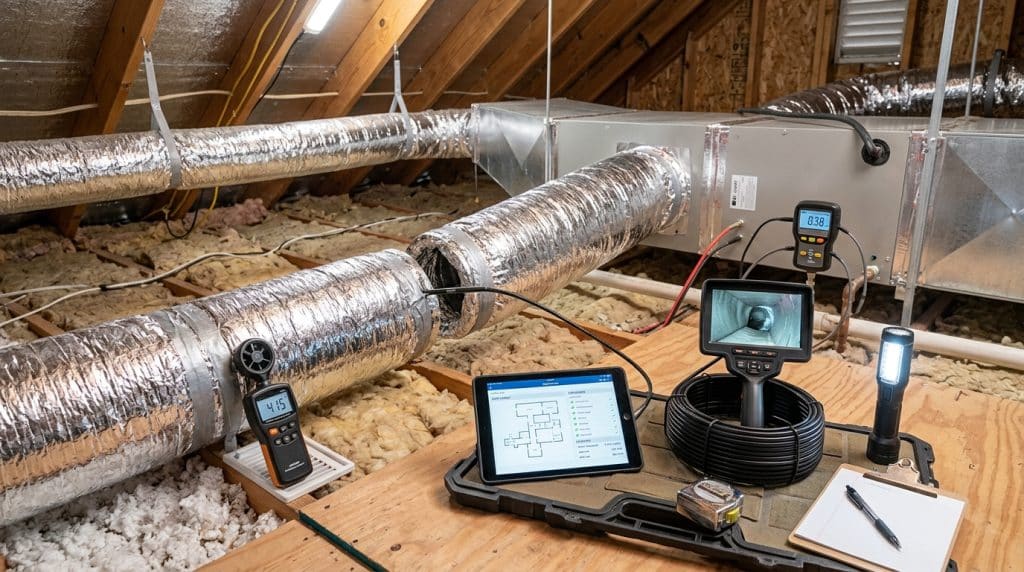
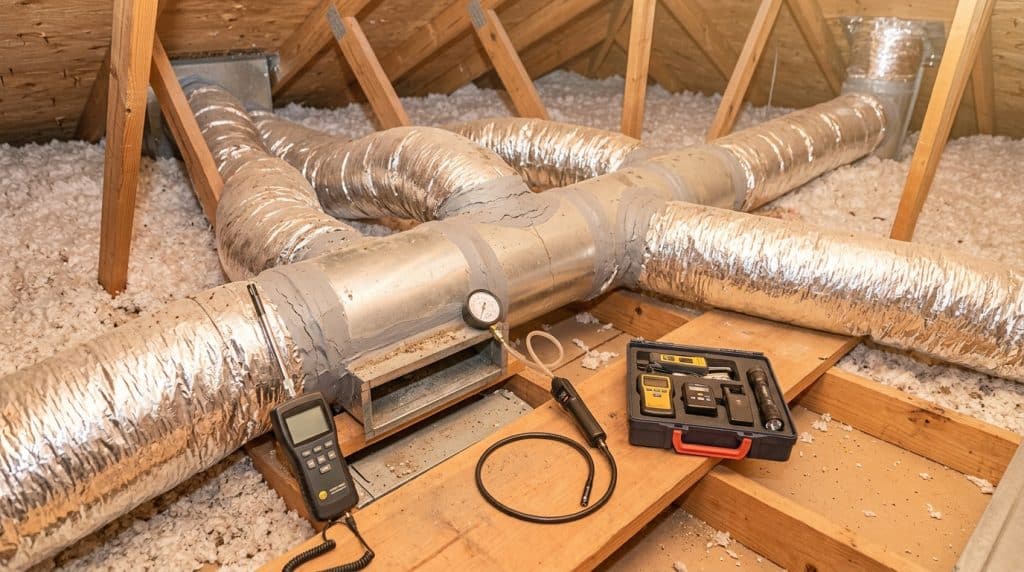
It’s a structured, documented evaluation of your entire duct system — inner liner condition, joint integrity, airflow at each register, and static pressure. Not a sales visit. Not a flashlight at the register face. Every visit ends with a specific finding you can act on.
- Camera + Airflow + Static
- Written Finding
- Available 24/7
Why It Matters Here
San Antonio Homes Put Duct Systems Under Conditions Most U.S. Cities Never See
San Antonio’s climate accelerates duct wear in ways that make inspection more important here than in most markets.
The AC season runs eight to ten months — nearly double a northern climate. Flex duct in a San Antonio attic goes through more thermal expansion and contraction cycles per year than the manufacturer’s lifespan rating assumes. Add fine limestone dust entering return intakes, Ashe juniper pollen from December through February, and the hard freezes that follow months of heat — stressing joints and mastic seals.
We serve homes from Loop 410 inward to the urban core and outward through the 1604 corridor into Cibolo and Schertz, with same-day and after-hours scheduling. Fifteen-plus years of inspections means we know what wear looks like in a 1975 home versus a 2005 one — and that difference matters when we read the findings.
From The Field · Ori Tarzi, Founder
What I Found When the Camera Went In
“A homeowner on the northwest side called because two bedrooms stayed warm no matter the thermostat setting. They’d had the HVAC unit serviced twice — the tech said the equipment was fine.
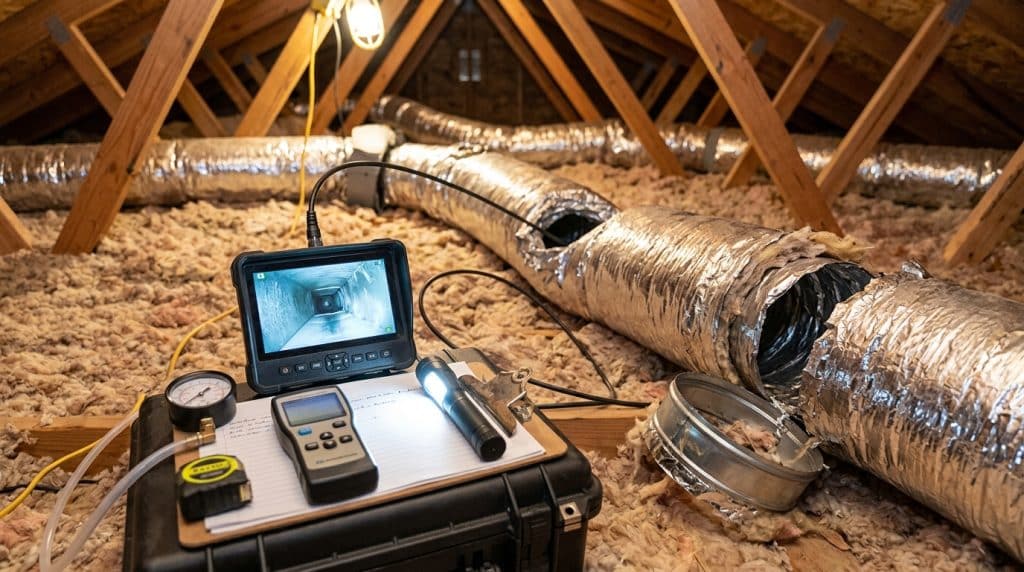
I started with airflow measurement — the volume of air, in CFM, reaching each register. The two warm bedrooms were getting about 40 percent of design. That pointed to the duct runs, not the air handler. The duct camera went in next: a collapsed section about twelve feet in on one run, a completely separated joint on the other. Both invisible from outside the duct; neither showed up in any prior visual inspection. A static pressure test confirmed both runs were generating excessive resistance the air handler fought on every cycle.
They didn’t need a new HVAC unit. They needed two targeted duct repairs — a fraction of a full replacement. The inspection is what made that clear. That’s the purpose of a duct diagnostic: not to find something to fix, but to find out whether there’s something worth fixing, and exactly what it is.”
Ori Tarzi
Founder, Green Air Duct Club
No Obligation
Every Inspection Ends With a Finding You Can Evaluate on Your Own Terms
A common concern is whether an inspection will lead to a list of services you didn’t plan on. Fair question. The inspection is the job: we measure, we document, and we tell you what we found in plain terms. If the ducts are in good condition, we say so. If a repair is needed, we show you where and explain why. If the system has reached end of life, we explain the criteria that point there. The finding is yours — you decide what to do with it.
The Checklist
What We Check on Every Duct Inspection Visit
We evaluate twelve specific conditions on every visit — duct integrity is assessed as a whole, not component by component in isolation.
- Airflow at each supply register — measured in CFM against the room’s design load.
- Return air grille condition — checked for restriction that reduces system airflow.
- Static pressure reading — tests resistance across the full duct system.
- Duct camera run on any section with suspected liner damage, separation, or debris.
- Joint integrity — every accessible connection evaluated for mastic or tape failure.
- Duct liner condition — inner surface assessed for collapse, stiffening, or biological growth.
- Insulation wrap condition — outer jacket checked for gaps, tears, or moisture.
- Supply & return balance — compared across rooms to find undersupplied zones.
- Air handler connection — the duct-to-equipment joint checked for leakage.
- Attic routing review — path assessed for unsupported spans, sharp bends, compression.
- Termination points — all supply and return boots checked for seal condition.
- Repair vs. replace decision point — a documented conclusion you can act on.
The Protocol
How We Run a Duct Inspection
Every inspection follows a consistent three-stage protocol — from first look to final finding.
01
Diagnostics
Airflow measurement at every supply register — numbers on paper, noting which rooms are undersupplied and by how much. Then a static pressure test to quantify system-wide resistance. High static pressure tells us there’s a restriction; it doesn’t tell us where. That’s what the camera is for.
02
Camera & Physical Assessment
We insert the flexible camera into each run showing abnormal airflow or elevated pressure, covering liner condition, joint integrity, and debris depth — plus a hands-on check of accessible joints, insulation, and support. A visual-only walkthrough stops where the camera begins; the first twelve to twenty feet is where most failures hide.
03
Documented Finding
A clear, written finding — what was measured, what the camera showed, and what it means for your decision. If repair is warranted, we identify locations and describe the work. If the system is beyond effective repair, we explain why. It ends with a number, a location, and a recommendation you can evaluate.
Where We Inspect
Duct Inspections Across Bexar County
We serve homes and commercial properties from the urban core near Downtown and Southtown outward through Alamo Heights, Stone Oak, Helotes, and Leon Valley, plus communities along the 1604 corridor including Converse, Schertz, and Fair Oaks Ranch. Same-day and after-hours inspection scheduling is available throughout Bexar County.
Bexar County & Surrounding Communities
- Downtown
- Southtown
- Alamo Heights (78209)
- Stone Oak (78258)
- Helotes
- Leon Valley
- Converse
- Schertz
- Fair Oaks Ranch
- 1604 Corridor
- Cibolo
- US-281 Corridor
Available 24/7
Start With the Inspection. Then Decide What Comes Next.
A duct assessment gives you information — not an obligation. We’ll assess your system, document what we find, and hand you a specific, documented finding. Once you have that, you’re in a position to make a real decision about your ducts.
Prefer email? Reach us at greenairductclubusa@gmail.com. Available 24/7 across the metro.
Common Questions
Air Duct Inspection in San Antonio: FAQ
Most residential inspections take 60 to 90 minutes, depending on home size and how many runs need camera evaluation. Larger homes with complex layouts — common in Stone Oak and Fair Oaks Ranch — may run closer to two hours. We don’t cut the inspection short to keep a schedule.
Clear access to your attic hatch and make sure all supply registers are accessible and uncovered. That’s it — we bring all diagnostic equipment, including the camera system, static pressure gauges, and airflow measurement tools.
No. The camera is a flexible probe inserted at the register boot opening. We don’t cut into duct material to inspect. If a section needs physical access for a camera pass, we use an existing access point or the register boot itself.
An inspection is a diagnostic service that evaluates structural condition, airflow, and joint integrity. A cleaning is a remediation service that removes accumulated debris from inside the liner. They’re separate services — and we can perform both on the same visit if the findings indicate cleaning is warranted.
Airflow measurements at each register in CFM, the static pressure reading for the full system, camera findings for each run evaluated, a description of any joint failures or liner damage located, and a clear recommendation — repair, clean, replace, or no action. Specific locations and findings, not general language.
No. The inspection is a flat-fee service. If your ducts are in good condition, we document that and you’re done. We don’t add charges based on what we find or don’t find. A clean result is a result.