Green Air Duct Club · Resource · San Antonio

Air Duct Repair vs. Replacement in San Antonio — How to Make the Right Call

Repair vs. replacement comes down to four measurable criteria — not contractor preference.
You’ve called two companies. One says repair, one says replace, both gave you a price — and neither explained the reasoning in terms you could evaluate. The decision isn’t a judgment call: it follows from four documented factors — system age, measured leakage percentage, damage extent, and duct accessibility. When you know what each measures and what it points toward, you can evaluate any quote on its merits.
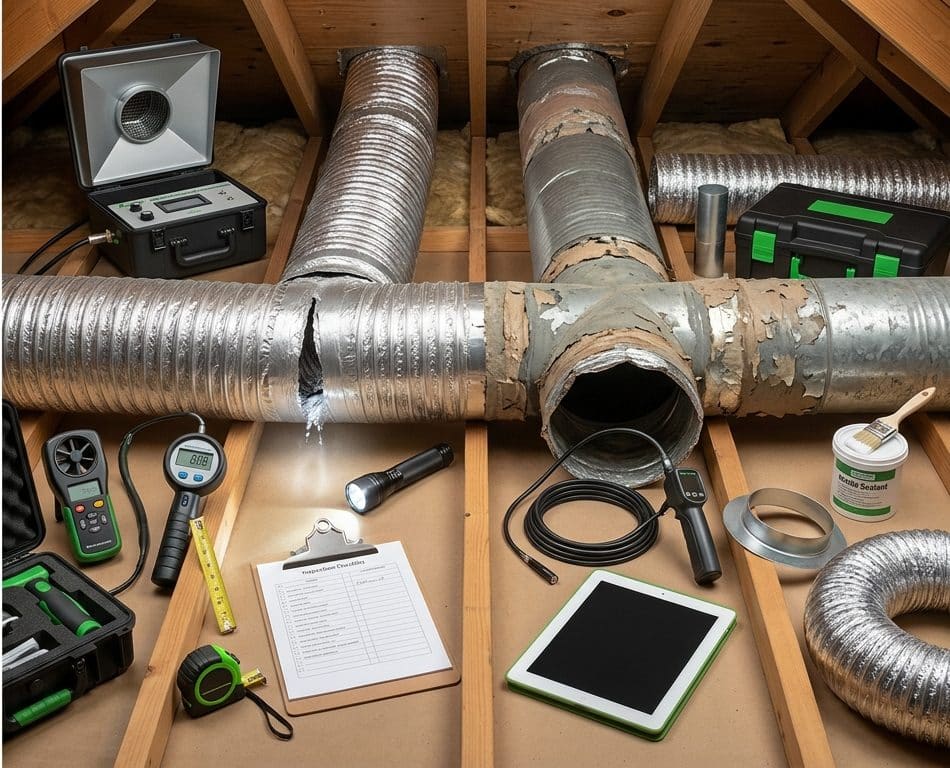
A professional HVAC inspection kit organized in wooden compartments, featuring damaged ductwork with visible tears and deterioration, alongside diagnostic tools including moisture meters, a thermal imaging camera, flashlight, measuring tape, clipboard with inspection form, tablet device, sealant, and coiled flexible ducting. The setup demonstrates equipment used for residential or commercial air duct assessment and maintenance work.
Four Criteria

The Cost Comparison That Drives the Repair-or-Replace Decision

The decision between duct repair and full system replacement isn’t a judgment call — it follows from four documented factors: system age, measured leakage percentage, damage extent, and duct accessibility. This page focuses on how those four interact to produce a financially sound recommendation, and what the cost crossover point looks like in practice. When you know what each factor measures and what answer it points toward, you can evaluate any quote on its merits.
By Construction Era

San Antonio Ductwork Has a Predictable History by Neighborhood

Fifteen years of assessments produces a clear pattern: construction era predicts duct condition. The West Side and South Side carry original duct from the 1970s and early 1980s — flex duct with a rated design life of roughly 20–25 years, now 40–50 years old. Newer developments off Loop 1604 and in the far northwest present a different issue: installation quality varies in volume-built subdivisions, and we’ve found duct failures in homes less than ten years old because joints were never properly sealed during construction. San Antonio’s 8-to-10-month cooling season compounds every shortcut — a poorly connected joint cycles stress here nine months a year.
Reasoning First

Ask for the Criteria Explanation Before Any Quote Is Attached

The reasoning behind the recommendation should be separable from the quote — if the logic is sound, it holds whether the number is $400 or $4,000. We walk through the four-criteria assessment (age, leakage, damage extent, accessibility) and explain the result in plain terms before any work is priced, so you can evaluate the recommendation as a technical conclusion, not just a number on a page. If two criteria point toward repair and two toward replacement, we explain how to weight them: age and leakage percentage carry more decision weight than damage extent alone, and accessibility affects cost more than it affects the technical recommendation. We explain the weighting. You decide.

Assessment Standards

Our Assessment Standards for San Antonio Duct Systems

Every repair-or-replace recommendation follows the same four-step assessment — documented and explained before any quote. No criterion operates in isolation.

System Age Threshold

We identify the installed duct material and cross-reference its design life. Flex duct older than 20 years is past its intended service life regardless of visible condition — it can look intact while the liner has stiffened and the mastic has failed.

Duct Leakage Measurement

We test leakage — we don’t estimate it. Systems above 15–20 percent measured total leakage are evaluated as replacement candidates, because cumulative repair cost approaches new-system cost at that threshold.

Damage Extent Mapping

We distinguish isolated failures (a failed joint, one crushed section) from distributed failures (mastic deterioration across multiple runs, liner degradation throughout). Isolated supports repair; distributed tips toward replacement.

Accessibility Evaluation

We note whether every failure point is physically reachable. Ductwork buried in closed wall cavities or routed through slab penetrations can cost more to access for repair than to route fresh through the attic.

Decision Reference

What Shapes the Repair-vs.-Replace Outcome

How each condition points — and how they interact when they conflict.

Flex duct system older than 20 years

Replacement

Measured leakage above 20%

Replacement

Leakage between 10–15%

Repair or seal

Single failed joint, otherwise intact

Repair

Mastic failure across 3+ duct runs

Replacement

Duct sections buried in wall cavities

Raises repair cost — evaluate replacement

Full attic access throughout

Neutral — no access premium

System under 15 years, leakage under 10%

Repair

When criteria conflict: age and leakage percentage carry the most weight. A 25-year-old system with distributed mastic failure points to replacement even if a single disconnected joint triggered the call — that joint reflects the same material-age deterioration affecting the rest of the system. The final check is the cost-of-repair vs. cost-of-replacement threshold: when repairing every identified failure exceeds 60–70% of replacement cost, replacement is almost always the stronger long-term decision. Pre-1985 West Side and South Side homes frequently hit that threshold on age and leakage alone; post-2000 homes in Converse, Schertz, and Helotes sometimes hit it on leakage and damage extent, where installation shortfalls accelerated failures.
Where We Serve

Repair & Replacement Across the San Antonio Metro

We serve every residential construction zone in the city — from 1970s-era West Side and South Side neighborhoods where original flex duct is at or past end of life, to growing communities along Loop 1604 and beyond, including Helotes, Converse, Schertz, Leon Valley, Alamo Heights, Stone Oak, and the full Bexar County metro. Available 24/7.
Bexar County & Surrounding Communities
Available 24/7

Get the Four-Criteria Answer Before Committing to Either Option

If you’ve received conflicting recommendations on your duct system, start with the framework. We’ll assess your system against all four criteria, explain what each one shows, and give you a clear direction — repair or replacement — before we attach a number to it.
Prefer email? Reach us at gr*****************@***il.com. Available 24/7 across the metro.