
Green Air Duct Club · San Antonio Since 2009

Does Your AC Unit Need Cleaning? Full Interior AC Cleaning in San Antonio

In most San Antonio homes, the answer is yes before homeowners expect it.
The symptoms aren’t always dramatic — a faint stale smell when the system first kicks on, a room that takes longer to cool, a small puddle near the air handler that wasn’t there last summer. Any of those points to a contamination load, and that load doesn’t sit in just one place. A full cleaning resets the whole interior.
An open HVAC air handler unit displays its internal components including a large centrifugal blower fan, evaporator coil with copper tubing, and various ductwork connections. The unit sits in an indoor installation space with cleaning supplies and tools visible nearby, including brushes and green-handled equipment positioned on the floor and work surface.
A disassembled HVAC air handler unit displayed with various cleaning and inspection tools arranged on a white surface below it. The system shows the upper and lower components with filters and ductwork, surrounded by diagnostic equipment including an inspection camera, cleaning brushes, spray bottle, flashlight, hoses, and a carrying case. This setup demonstrates professional air conditioning or heating system maintenance and inspection tools.
A Full Interior Reset

Your AC Unit Needs More Than a Coil Wipe — It Needs a Full Interior Reset

AC cleaning addresses the system’s full interior contamination pattern — blower wheel, drain pan, drain line, cabinet, and coil together.
The outdoor environment accelerates what builds up inside. Live oaks drop pollen February through April; Ashe juniper (cedar) blows in from the Hill Country edge December through February, penetrating standard 1-inch filters at particle sizes the media can’t stop; and construction along the 1604 outer loop and southwest side adds fine limestone particulate around outdoor units.
That material finds its way inside — onto the blower wheel that moves conditioned air, into the condensate drain pan beneath the coil, and across the cabinet interior. A cleaning that only addresses the coil fins touches one surface. A full AC cleaning covers every interior component.
From The Field · Ori Tarzi, Founder

What Ori Tarzi Finds Inside a San Antonio AC Unit
“From Helotes to Converse, the story inside the cabinet is usually the same. The coil looks fine at a glance — clean fins, no visible fouling — but the homeowner is still getting a musty smell at startup and the system runs longer than it should. When I open the cabinet and look at the blower wheel, that’s usually where the story is.
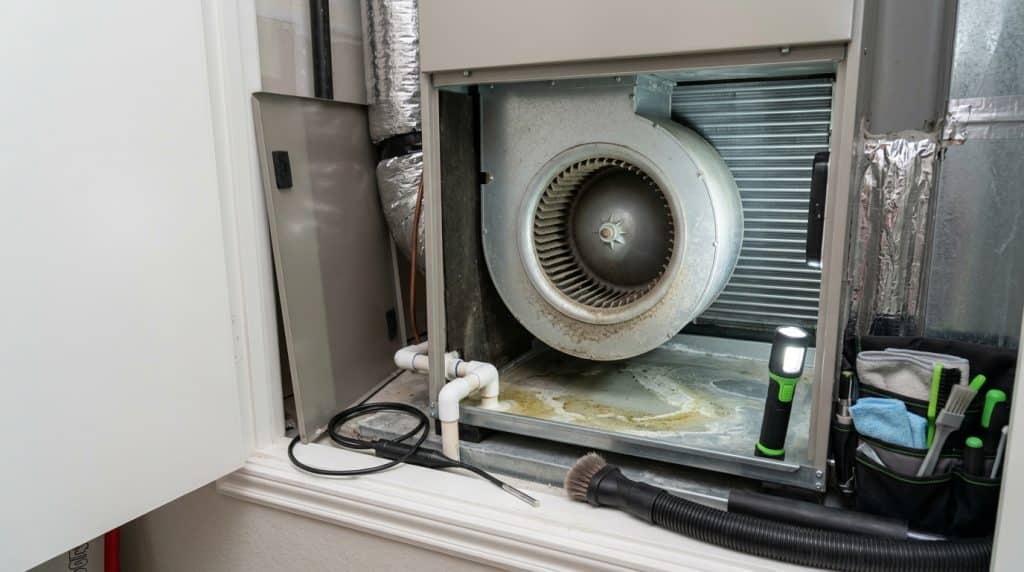
The blower wheel picks up a thin layer of particulate every cycle — and it doesn’t stay thin. In a home running eight to ten months of cooling a year, the wheel accumulates enough debris on its blades to measurably reduce airflow. I’ve pulled wheels carrying a quarter-inch coating of compacted dust and organic material. The system was running, the thermostat responding, but the air volume reaching the rooms was significantly reduced.
The drain pan tells its own story — a warm, wet tray where algae establishes fast, backs up, and overflows into the puddle near the air handler. The drain line is one of the most common causes of water damage near HVAC equipment in this city; it takes minutes to clear during a visit and far more to fix after it’s damaged a ceiling.”
Ori Tarzi
Founder, Green Air Duct Club
Interior view of an HVAC system housing showing a large circular inline duct fan with visible dust accumulation on its housing and surrounding surfaces, accompanied by white PVC piping, black flexible ducting, and cleaning supplies stored in a caddy on the right side. The metal-lined compartment displays signs of wear and neglect, with discolored surfaces and debris indicating the system requires maintenance or cleaning.
Scope Matched to Your System

Does My Whole System Really Need to Be Cleaned?

A partial cleaning addresses a symptom; a full interior cleaning addresses the accumulation pattern — which is never limited to one component here. Before any cleaning begins, we access the cabinet and identify which components carry the most contamination. That takes five minutes and tells us whether the blower wheel is the primary issue, whether the drain pan needs clearing, and whether the coil is involved at all. You’re not paying for a blanket procedure — you’re paying for a cleaning that addresses where the contamination actually is.

How We Clean

How We Approach Full AC System Cleaning

Every AC cleaning covers the full interior — blower wheel, drain pan, cabinet, drain line, and coil — not the coil face alone.

Blower Wheel Cleaning

Each blade surface cleared of accumulated debris — removal and full-surface cleaning of the wheel itself, not a wipe of the visible face.

Drain Pan Treatment

Pan cleared of algae, organic debris, and standing water; the drain line is flushed and confirmed clear before the job closes.

Cabinet Interior

Interior surfaces wiped down to remove particulate and any biological growth living in the humid cabinet environment.

Coil Inspection

Coil condition assessed and cleaned where fouling is present — distinguished from the blower wheel and pan, which are separate accumulation sites.

Airflow Confirmation

System restarted and airflow confirmed at supply registers before we leave the property.

Diagnosis To Confirmation

How a Full AC Cleaning Works

From the air handler assessment through verified airflow — in sequence.
01

Starting With the Air Handler

We remove the cabinet access panel and inspect the interior — contamination at the blower wheel, drain pan condition, and coil face — before any cleaning begins. Heavier blower-wheel contamination means that’s addressed first, before coil work, so loosened debris doesn’t recontaminate a cleaned coil.
02

Cleaning Each Component in Sequence

The blower wheel is removed or accessed in-place by model, and each blade cleaned with tools appropriate to its material. The drain pan is cleared and treated; the drain line flushed and confirmed open from pan to exterior. Cabinet interior wiped down. Coil fins cleaned where fouled, using a no-rinse cleaner rated for residential evaporator surfaces.
03

Confirming the System Before We Leave

Power back on. We confirm drain-line flow (water at the pan must exit cleanly outside), verify airflow at supply registers throughout the home, and check that the musty odor — dirty sock syndrome — is gone. If it’s still present, we identify the residual source before leaving.
Where We Clean

AC Cleaning Across the San Antonio Metro

AC unit cleaning is available across the full metro, seven days a week — homes near Lackland AFB, along the 151 corridor, southeast Bexar County near Brooks City Base, the Near Northwest Side, Stone Oak, Alamo Ranch, Helotes, Converse, and the urban core. Scheduling is available 24 hours a day.
Bexar County & Surrounding Communities
Available 24/7

Ready to Schedule Your AC Cleaning in San Antonio?

A completed cleaning leaves you with a system that moves the air volume it’s rated for — without the startup odor or the slow-cooling symptom that brought you here. Tell us what you’ve been noticing and we’ll match the scope to what your system actually needs.
Prefer email? Reach us at gr*****************@***il.com. Available 24/7 across the metro.
Common Questions

AC Cleaning in San Antonio: FAQ

Coil cleaning addresses one surface — the evaporator coil fins. A full AC cleaning also covers the blower wheel, condensate drain pan, drain line, and cabinet interior. In most San Antonio homes, the blower wheel and drain pan carry more contamination than the coil face by the time a homeowner notices a problem.
Most homes benefit from a full interior cleaning every one to two years, depending on runtime. Systems running eight to ten months a year accumulate debris faster than homes in milder climates. A musty odor at startup or rooms cooling more slowly than they used to are indicators to schedule regardless of when the last cleaning happened.
Yes — in most cases it’s the most impactful single component we clean. A wheel carrying a quarter-inch of compacted debris can reduce the volume of conditioned air reaching your rooms by a measurable margin. After cleaning, homeowners typically notice faster cool-down and more even temperatures between rooms.
That odor — sometimes called dirty sock syndrome — is produced when biological growth on the blower wheel or coil disperses into the air stream the moment the system starts. It’s most common here because the long cooling season keeps the system wet and warm inside for months. Cleaning the affected components eliminates it at the source.
Yes, and it’s one of the more common sources of water damage near HVAC equipment in San Antonio. When the condensate line clogs, water backs up into the pan, overflows, and can damage ceilings, walls, or flooring near the air handler. Clearing the line during a routine cleaning takes minutes; repairing the resulting damage does not.
Older air handler models — common in homes built in the 1970s through 1990s — sometimes require in-place blower wheel cleaning rather than full removal, depending on cabinet configuration. We adjust the access method to the equipment; the cleaning standards don’t change.