Green Air Duct Club · Resource · San Antonio

How San Antonio’s Climate Destroys Air Ducts Faster Than Most U.S. Cities

San Antonio runs air conditioning eight to ten months a year — most U.S. cities run it four to six.
Our cooling season is nearly twice the national average, and that’s the single biggest reason a duct system in a San Antonio attic accumulates wear faster than the same materials would elsewhere. Manufacturer lifespan ratings — typically 15 to 20 years — assume average operating conditions. San Antonio isn’t average: thermal cycling hours stack up here at a rate those ratings never assumed, compounded by caliche particulate and periodic Arctic intrusions.
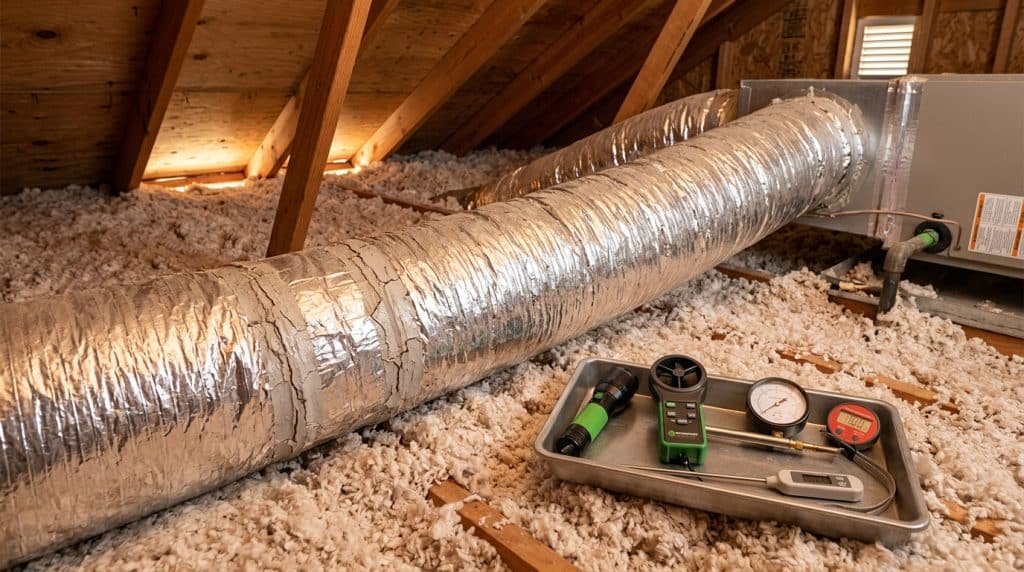
An attic space showing an HVAC ductwork inspection setup with a flexible silver insulated duct running across insulation material, accompanied by various diagnostic tools on a tan tray including a digital anemometer, thermometer, and other measuring instruments used for air quality and ventilation assessment.
Why Here

Why This Question Matters More in San Antonio Than Almost Anywhere Else

San Antonio’s geography stacks multiple climate stressors on a duct system at once — no single factor explains the accelerated wear. Duct systems in many U.S. climates get a genuine rest period: they run hard for a few summer months, then sit idle through a long winter while materials stabilize and mastic settles. Here, the operating season stretches from March through November and often beyond, so the system rarely fully rests. Attic temperatures regularly exceed 140°F on the hottest afternoons — the outer insulation wrap degrades, the inner liner stiffens, and joints begin to separate from the steady accumulation of thermal cycling hours across a decade-plus of long Texas summers.

The Full Picture

Four Climate Stress Factors That Shorten Duct Lifespan

Each one compresses the flex-duct degradation timeline on its own — all four work together, year after year.

Extended Season & Thermal Cycling

A four-month-season system runs roughly 800–1,000 expansion/contraction cycles a year; San Antonio’s eight-to-ten-month season approaches 2,000+. Repeated cycling cracks mastic away from connections, opens joints, and stiffens liners until they crack — a compounding failure specific to long-season climates.

Limestone & Caliche Particulate

Wind across the exposed caliche and limestone of the Balcones Escarpment carries abrasive particulate into return-air intakes across Bexar County. It’s coarser and denser than ordinary urban dust, deposits on coils and liners, and standard filters don’t catch all of it — especially during high-wind spring and fall events near Leon Valley and Converse.

Pollen Loading & Filter Saturation

Ashe juniper from late December through February, then live oak February through April — four-plus consecutive months of heavy filter stress. When filters saturate in days instead of weeks, unfiltered particulate bypasses the media and enters the ducts directly, establishing on liner surfaces that never fully dry in spring humidity.

Arctic Intrusion Freeze-Thaw

Hard freezes arrive as thermal shocks — 40 to 50 degrees dropped within 24 to 48 hours after months of warmth. For duct thermally expanded through summer and fall, that rapid contraction accelerates joint separation and liner cracking in ways gradual northern transitions never do, especially where mastic is already compromised.

By Neighborhood

How This Plays Out Across San Antonio Neighborhoods

Construction era predicts duct condition with reasonable accuracy. Alamo Heights & Beacon Hill (pre-1970): original installs now 40–50 years old, typically revealing joint failures, disconnected runs, and liner deterioration across multiple sections. Leon Valley & South Side (1970s–80s): aluminum flex or early fiberglass-lined systems that have often held up, but mastic failure and insulation-wrap degradation are common after four-plus decades — the classic repair-or-replacement decision point. Stone Oak & Helotes (1990s–2000s): flex duct now 20–30 years old, showing joint separation and liner stiffening two to four years ahead of what the timeline predicts in milder markets — because they’ve accumulated thermal cycling hours at San Antonio’s pace.
Watch For These

What the Climate Data Tells You to Watch For at Home

The downstream signatures of those four failure mechanisms — observable before you call anyone.
01

Uneven Cooling Between Rooms

Rooms that used to cool at the same rate now behave differently — one stays comfortable, another stays warm regardless of the thermostat. Joint separation or liner collapse in a single branch run starves one zone while others are unaffected. The equipment is fine; the delivery system has a specific failed section.
02

A Steadily Climbing CPS Energy Bill

Conditioned air escaping through separated joints into an unconditioned attic registers as load — the air handler runs longer to compensate, and the bill reflects it. Common in 1980s–90s homes across Leon Valley, the South Side, and older Stone Oak corridors.
03

Dust Returning Faster After Cleaning

Particulate settled inside liners over years of pollen seasons and caliche accumulation gets re-suspended during operation and redistributes through the supply registers. Homeowners blame outdoor air or housekeeping; often it originates inside the duct system itself. None of these is diagnostic alone — they’re the reason to schedule a measurement, not a substitute for one.
Where We Assess

Climate-Damaged Duct Systems Across the San Antonio Metro

We serve duct inspection, repair, and replacement calls across the metro — from Alamo Heights and Beacon Hill, where original installs are now 40–50 years old, to newer builds in Helotes, Stone Oak, and the outer Bexar County growth corridors where climate stress is shortening expected duct lifespans.
Bexar County & Surrounding Communities
Available 24/7

Get an Accurate Picture of Your Duct System’s Condition

The only way to know what San Antonio’s climate has done to your specific system is to look at it directly. An inspection gives you the specifics — joint integrity, mastic condition, liner status — and a clear picture of what action, if any, makes sense for your home.
Prefer email? Reach us at gr*****************@***il.com. Available 24/7 across the metro.