Green Air Duct Club · Resource · San Antonio

Mountain Cedar Season in San Antonio — What It Does to Your HVAC System

Mountain cedar season is a real HVAC event — not just an allergy problem.
From December through February, Ashe juniper across the Hill Country releases pollen in concentrations among the highest recorded anywhere in the continental U.S. — events above 15,000 grains per cubic meter are common. Your HVAC system runs through all of it, pulling that air in, through a filter, across a coil, and into every room. What it does inside the system compounds stage by stage, and it doesn’t clear on its own.
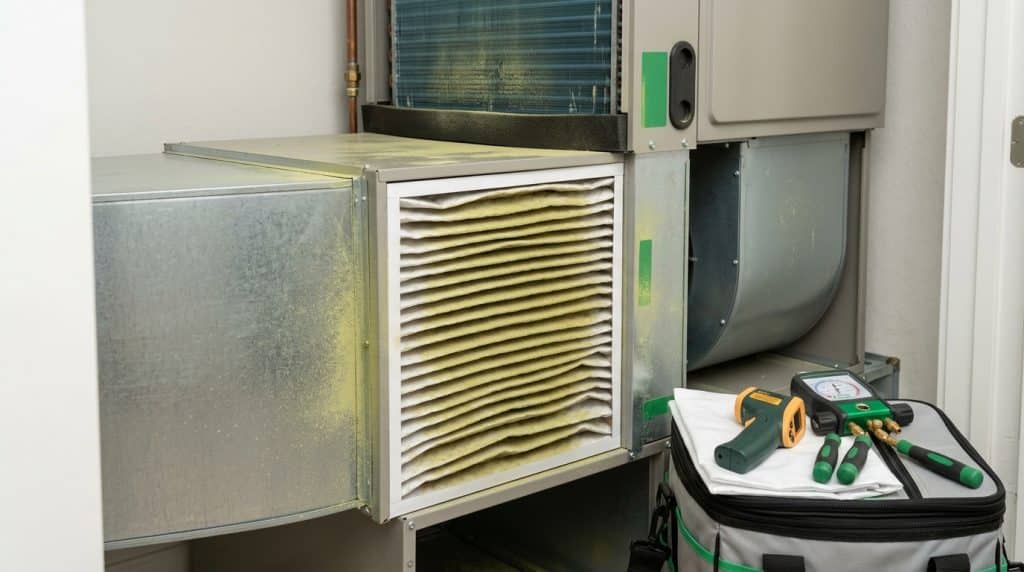
An HVAC technician's workstation showing an open air handling unit with a clean pleated air filter exposed, alongside a green and black tool bag containing various diagnostic instruments and testing equipment positioned on a white cloth surface in what appears to be an indoor installation or maintenance space.
The Whole Metro

San Antonio Sits at the Edge of the Cedar Belt — and That Matters

The city sits at the eastern edge of the Hill Country, where Ashe juniper — locally called mountain cedar — dominates. The northwest quadrant, from Helotes toward Leon Valley, receives peak pollen loads first and heaviest during a cedar event. But it doesn’t stay northwest: prevailing winter winds push cedar pollen east and south across Bexar County during January surges, and homes on the South Side, East Side, and in Stone Oak all record meaningful concentrations. Every HVAC system in the metro is running through cedar-season air — the question is how ready your system is to handle it.
The Sequence

What Cedar Season Actually Does Inside Your HVAC System

Cedar pollen moves through the system in a predictable sequence — each stage compounds the next.
01

Filter Saturation

Ashe juniper grains run 20–30 microns. Standard 1-inch MERV 4–6 filters are built to reach capacity in 30–90 days under normal conditions — but during a peak cedar event that collapses to 3–7 days. A saturated filter doesn’t just stop filtering: airflow restriction rises, static pressure builds, and particles bypass at the media edges. The system keeps running and the filter still looks like a filter — but it’s no longer doing its job.
02

Pollen Bypass to the Coil

What bypasses the filter reaches the evaporator coil, which runs wet with condensation. Cedar pollen that lands on a wet fin adheres, binds with existing deposits, and creates a biological growth substrate that outlasts February. Coil fouling from a single heavy season measurably reduces heat-transfer efficiency — the system works harder across a partially blocked surface, and utility bills climb in spring until someone removes it.
03

Duct Accumulation

What clears the coil keeps moving into the duct runs. In the ribbed, fiberglass-lined flex duct common here, cedar pollen adheres to the liner during high-concentration airflow and accumulates across seasons, becoming part of what recirculates each time the system runs. By March the season’s full load has finished depositing — which is why spring is the more important cleaning window for many homeowners.

Two Situations

Two Scenarios San Antonio Homeowners Actually Face

Pre-season preparation and post-season recovery are distinct situations — and they call for different actions.

The On-Schedule Filter Changer

An Alamo Ranch homeowner swaps a 1-inch MERV 6 every 60 days — reasonable in spring and fall. They replace on December 1st; by January 8th cedar peaks; by the 15th the filter is saturated; they don’t check again until February. For three weeks the system ran with effectively no filtration and the coil caught everything. The fix isn’t more diligence — it’s checking every seven days from December through February and replacing on condition, not calendar.

The Post-Cedar Service Scheduler

A Stone Oak homeowner runs through cedar season, changes filters when they remember, and books their tune-up in October. By March the coil has three months of pollen adhesion and the ducts a season’s loading — and oak pollen starts in February, grass in April. They head into the second allergy season already fouled. A post-cedar coil cleaning and duct inspection in March or early April clears that load before spring pollen adds to it.

When To Call A Pro

When Bringing in a Professional Makes Sense

A filter swap during cedar season is something you can manage yourself — check weekly from December through February, replace when it looks loaded, and upgrade to a higher-MERV filter if your system’s static-pressure tolerance supports it. For the filtration hardware itself — which product to install and how MERV ratings match your duct system’s capacity — our whole-home air filtration page covers that in detail. This page is about the downstream damage.
Beyond filtration, coil fouling and duct accumulation from a full cedar season need professional equipment and access. An evaporator coil cleaning, a post-cedar duct inspection, and a drain-pan check after a heavy season clear what filters can’t. If your system ran through cedar season without filter management, a spring service call in March or April addresses the accumulated load before oak and grass pollen add to it.
Where We Serve

Cedar-Season HVAC Service Across the San Antonio Metro

We take pre-season and post-season cedar calls from homes and commercial properties throughout Bexar County — northwest-quadrant neighborhoods closest to the Hill Country cedar belt, the urban core along Loop 410, and growth-corridor communities across the outer metro. If you’re in the San Antonio metro, we serve your area.
Bexar County & Surrounding Communities
Available 24/7

Cedar-Season HVAC Protection: One Call Before December, One After February

Pre-season: a coil inspection and system check before cedar begins — we confirm coil cleanliness, drain-pan condition, and the right filter for your static-pressure tolerance. Post-season: a coil cleaning and duct inspection in March or April, after the full pollen load has deposited. Both windows matter.
Prefer email? Reach us at gr*****************@***il.com. Available 24/7 across the metro.