Green Air Duct Club · San Antonio Since 2009

Air Duct Repair in San Antonio: What’s Wrong and How We Fix It

Air duct repair in San Antonio addresses specific, named failures — not a vague sense that the system isn’t performing.
We’ve been diagnosing and repairing ductwork in San Antonio homes since 2009 — rated 4.8★ across 283 Google reviews. These systems fail in predictable ways — and every repair starts by finding the actual failure, not guessing at it. Available 24/7 across the metro.

What We Actually Fix

The Five Duct Failures We Find Most in San Antonio Homes

Flex duct was standard in homes built across the 1970s, 1980s, and 1990s — systems now 30 to 50 years old. San Antonio attics push past 140°F every summer, and Arctic fronts drop temps 40 degrees in a day. That thermal cycling pulls joints apart and dries out mastic. Here’s what that looks like.

Joint Separation

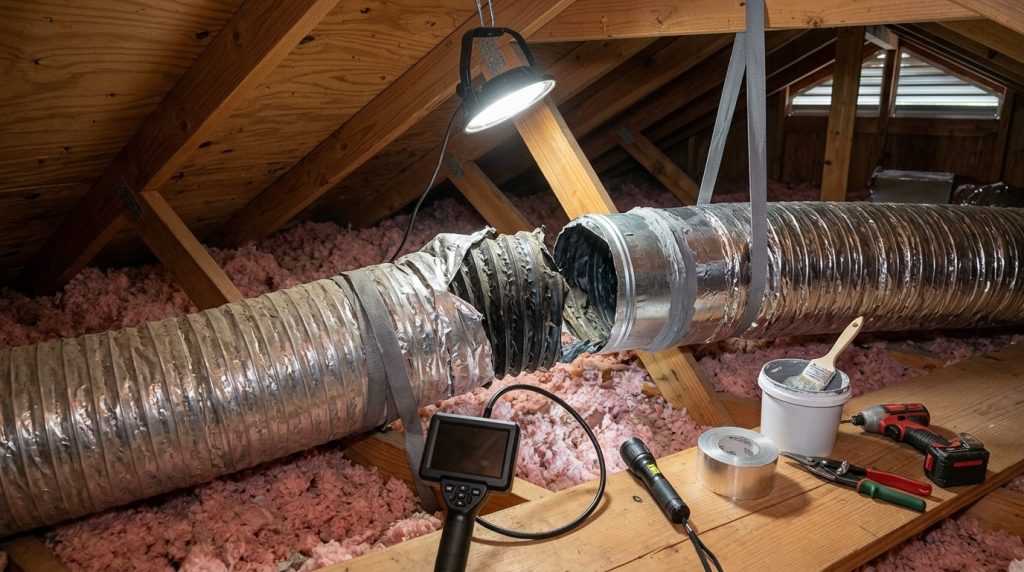
A duct joint pulls apart where two sections connect. Conditioned air escapes into the attic instead of reaching the room. The HVAC unit keeps running. The room stays warm.

Collapsed Liner

The inner plastic sleeve of a flex duct collapses or kinks. Airflow drops sharply. The room furthest from the air handler suffers most.

Mastic Failure

Mastic sealant — the paste-like compound applied to duct joints for an airtight seal — dries out and cracks after years of thermal cycling. Small gaps become significant leaks over time.

Rodent Intrusion

Animals nesting in attic duct runs shred the outer insulation wrap and puncture the inner liner — more common in San Antonio’s older housing stock than most homeowners realize.

Disconnected Return Air Duct

The return duct that pulls air back to the HVAC unit for reconditioning separates completely. The result is pressure imbalances across the home and a system that runs without reaching its target temperature.
Patterns We’ve Learned

What 15 Years of San Antonio Duct Calls Tells Us

Ductwork repair in San Antonio follows clear patterns tied to when and where a home was built.
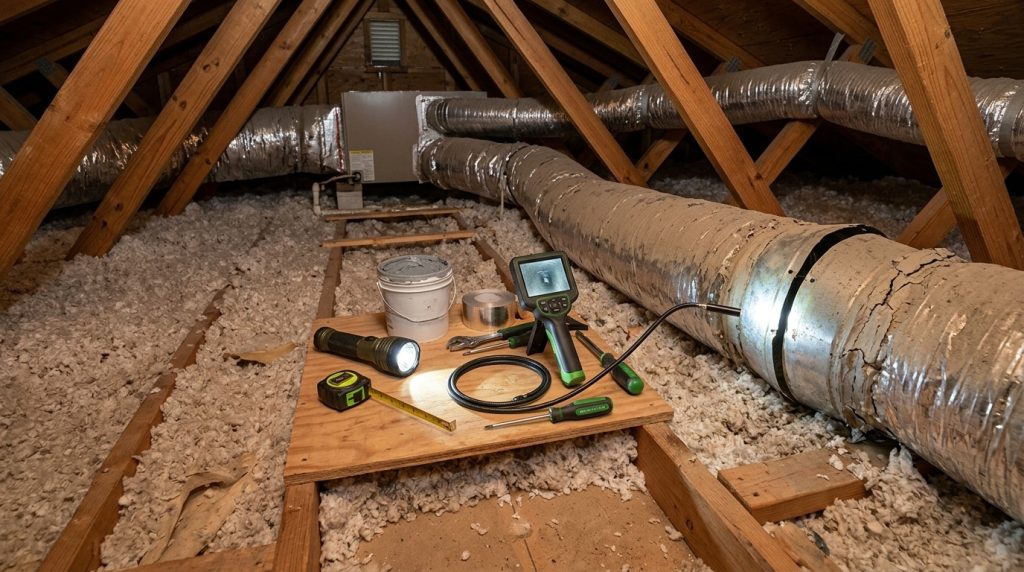
Leon Valley, the South Side, and neighborhoods along Loop 1604’s inner edge share a common problem: original flex duct installed in the 1970s and 1980s that has long outlived its 15-to-20-year design life. Joints pull apart quietly. The air handler keeps running. The homeowner adjusts the thermostat and wonders why the bill is climbing.
San Antonio’s duct systems carry a heavier operating load than most U.S. cities. The cooling season stretches across most of the calendar year, and the attic environment these ducts run through accelerates material degradation. A joint that might hold for 25 years in a milder climate fails in 15 here. We dispatch 24/7 across the metro — including Alamo Heights, Leon Valley, and the Loop 1604 corridor.
From The Field · Ori Tarzi, Founder

What I Found Last Summer in a 1987 Home on the South Side
“A homeowner off Military Drive had one bedroom that ran warmer than the rest all summer. They’d already replaced the HVAC unit the year before — new equipment, same problem.
I pulled the attic access and went in. The flex run serving that back bedroom had a joint separation about 14 feet from the air handler — well past what a visual check from the access panel would catch. The inner liner had also stiffened enough to restrict airflow before the separated joint even factored in. Two failures at once, and neither would have shown up on a basic walkthrough.
We sealed the joint with mastic and a sheet metal collar, then replaced the degraded section with a properly supported new run. Two repairs, one visit. That bedroom cooled down for the first time in years. The lesson from hundreds of jobs like it: a real repair accounts for what the camera and tape measure reveal — not just what’s visible from the hatch.”
Ori Tarzi
Founder, Green Air Duct Club
Straight Answers

What Happens When We Find More Than One Problem

Some homeowners wonder whether an inspection will produce a longer list of repairs than they planned for. That’s a fair question — here’s how we handle it. Before anything is quoted, we identify every active failure in the system and present them in plain terms. We explain which failures are causing your symptoms and which are minor enough to monitor. You decide what gets repaired in this visit.
Air balancing — each room receiving the volume of conditioned air it was designed for — only happens when the full repair scope is addressed. Every item on the quote gets explained. Every explanation is straightforward.
How We Repair

Repair Methods Matched to the Failure

Every repair uses materials and methods matched to the specific failure type in your duct system.
Foil tape is not used as a primary sealant on flex duct joints. It does not hold under the temperature range San Antonio attics reach in July.
Start To Finish

How Ductwork Repair in San Antonio Gets Done

The repair process runs from diagnostic to verified airflow — every step in sequence.
01

Diagnostics

We pull the attic access, trace duct runs visually and by camera where they extend out of sight, and identify every active failure — joints, liner, insulation wrap, support spacing, and static pressure. The quote comes after this step, never before.
02

Implementation

Each failure gets its correct method. Joint separations get mastic-and-collar connections; degraded sections are replaced at the full affected run with proper support and correct bend radii; disconnected returns are reconnected at the boot, sealed, and tested for draw.
03

Post-Service Testing

We run the system and verify airflow at the supply registers on the repaired runs, confirm improved volume to any room that was undersupplied, and check return draw at the grilles. You get a plain summary of what was found and done.
Where We Repair

Duct Repair Across the Full San Antonio Metro

Green Air Duct Club completes HVAC duct repair calls throughout Bexar County — Leon Valley, Alamo Heights, the South Side, and the Loop 1604 corridor — plus Converse, Schertz, and surrounding communities. Calls are dispatched 24 hours a day, seven days a week, with no fixed schedule limiting after-hours availability.
Bexar County & Surrounding Communities
Available 24/7

Ready to Fix the Real Problem in Your Duct System?

Disconnected duct repairs and broken air duct fixes start with finding the actual failure — not guessing at it. Serving San Antonio since 2009 — 4.8★ across 283 Google reviews. Tell us what you’re noticing (uneven temperatures, higher bills, visible duct damage) and we’ll schedule a diagnostic visit. The repair quote comes after we’ve seen the system.
Prefer email? Reach us at gr*****************@***il.com. Available 24/7 across the metro.
Common Questions

Air Duct Repair in San Antonio: FAQ

Most repair visits take two to four hours, depending on how many failure points are found. Diagnostic work runs first — pulling the attic access, tracing duct runs, and identifying every active failure. Repairs follow immediately in the same visit when materials are on hand. A single joint separation typically takes under an hour; multiple failures add time proportionally.
Costs range based on failure type, number of affected sections, and attic access conditions. A single joint reconnection costs significantly less than replacing a collapsed 15-foot flex run with a disconnected return on the same call. We quote after diagnosing — not before — so the number reflects the actual scope of work, not an estimate built before anyone has seen the system.
You decide what gets repaired. We identify every active failure during the diagnostic step and present them in plain terms, explaining which are causing your symptoms and which are minor enough to monitor. Nothing gets added to a quote without explanation. A complete repair restores air balancing across the home; a partial repair addresses the failures you choose to prioritize first.
Yes. A disconnected return creates pressure imbalances across the entire system, not just the nearest room. The air handler pulls less air than it needs, static pressure rises, and supply airflow drops to every room. Reconnecting and sealing it correctly at the boot restores system-wide pressure, typically with noticeable improvement within one full cooling cycle.
Foil tape does not hold under the temperature range San Antonio attics reach in summer — regularly past 140°F, which causes the adhesive backing to fail within one to two seasons. Mastic sealant is brushed directly onto the joint and cures into a flexible, airtight bond that withstands the thermal cycling this climate produces year after year.
Repair is appropriate when failures are isolated — a single joint separation, one collapsed section, or a disconnected return in an otherwise sound system. Replacement becomes the call when degradation is distributed across the full network, when the material has stiffened and cracked throughout, or when the system is more than 20 years old with compounding failures on multiple branches. The diagnostic visit answers this for your system before any work is quoted.