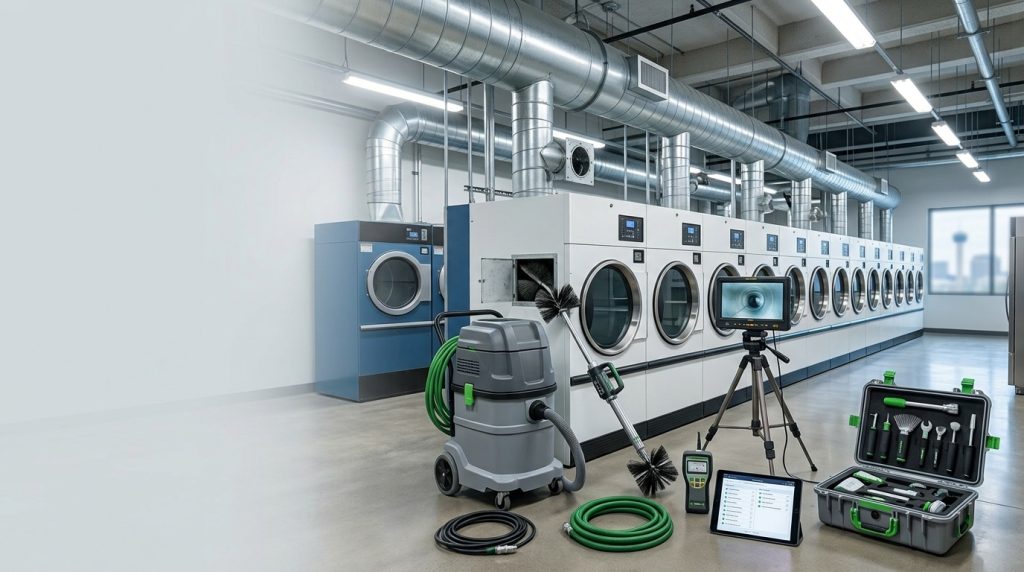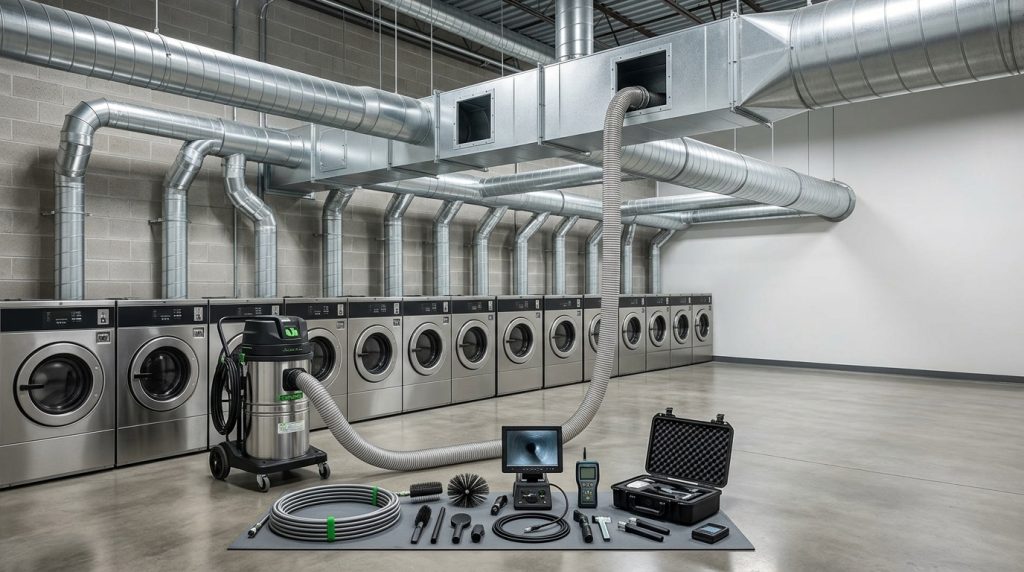
Green Air Duct Club · San Antonio Since 2009

Commercial Dryer Vent Cleaning in San Antonio — Airflow Verified & Documented at Every Line

High-volume dryer vents need a different cleaning approach than residential lines — and airflow verified and documented at every line serviced.
A household dryer runs a few loads a week; a hotel linen facility, assisted living laundry, or apartment laundry center may run dozens a day — changing how lint accumulates, how fast a partial blockage develops, and what equipment and access the cleaning requires. We schedule every visit around your operating window and document airflow before and after at each vent line. Rated 4.8★ across 283 Google reviews.
A Different Category

Why High-Volume Dryer Vents Need Commercial-Grade Cleaning

Cycle volume changes everything about how lint accumulates and what the cleaning requires.
Residential runs are typically under 25 feet from machine to cap. Commercial runs in multi-story facilities can exceed 50 feet, change direction through wall cavities, and terminate through roof assemblies rather than sidewalls — and cleaning a run that length requires equipment with the airflow capacity to pull debris from its full length.
The lint accumulation rate in a high-volume facility can be four to six times higher per month than a single-dryer household. A facility running 20 dryers eight hours a day isn’t on the same service interval as a homeowner’s dryer — that rate dictates cleaning frequency, and getting it right requires knowing the numbers.
From The Field · Ori Tarzi, Founder

From the Field: Cleaning Commercial Laundry Facilities Across San Antonio Since 2009
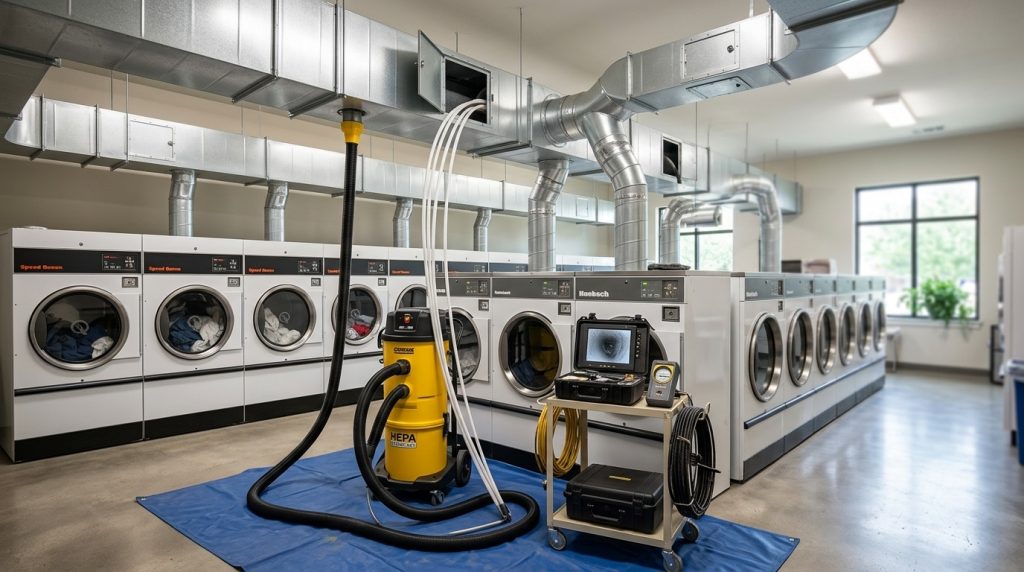
“Since 2009 we’ve worked inside hotels near the convention district, assisted living communities on the Northwest Side, and apartment laundry centers along the 1604 corridor. That experience produces familiarity with how San Antonio’s specific facility types are built and how their vent systems route through them.
The problem isn’t just volume — it’s volume, heat, and run length together. In a laundry operation running 30 to 50 loads a day, each shift adds another layer of lint, and the heat from continuous cycles bakes those layers into the duct wall. Partial blockage develops faster than the maintenance calendar accounts for, and often faster than any visible symptom appears at the machine.
Assisted living facilities here often carry intensive daily volumes alongside state health-licensing oversight, so a cleaning visit feeds directly into the compliance record. A fire marshal inspection is a common trigger — facilities discover mid-cycle blockage during a regulatory review rather than through performance changes they could observe beforehand. We schedule around the operating window: early mornings, evenings, weekends. The laundry doesn’t pause for us — we work around it.”
Ori Tarzi
Founder, Green Air Duct Club
Documented Every Line

Airflow Verified & Documented at Every Vent Line

A facilities manager facing a fire marshal inspection needs more than a verbal confirmation that the work was done — they need documentation. Airflow verification — a measurable confirmation the run is fully clear from collar to cap — is expressed as a pressure differential or CFM reading at the termination point. We record that reading before cleaning begins and again after the job is complete; the difference confirms exactly what was obstructing the line and that it’s been cleared. That written record satisfies insurance documentation requirements and is in hand after every visit — part of what the job delivers.

Our Protocol

Frequency, Access, and Documentation

Our commercial protocol covers the three variables that determine whether a job is complete.

Facility-Specific Frequency

We assess machine count, daily cycle volume, and run length to set the right service interval for each facility — not a default applied uniformly.

Full-Run Access

Every cleaning begins at the machine connection collar and runs to the exterior or roof cap — no partial passes that leave the middle of a long run untouched.

Pre- & Post-Airflow Readings

Taken at the termination point before and after every cleaning, with both readings recorded in the job documentation.

Scheduled Around Facility Hours

Morning, evening, and weekend availability across the metro — coordinated to fit the facility’s operating calendar.

Material-Appropriate Tools

Roof-assembly and shared-wall runs require different brush diameters and rod lengths than residential runs — we carry both.

Single Coordinated Visit

How We Service Multiple Vent Lines in One Facility Visit

Access planning, line-by-line cleaning, and a documented reading at every termination.
01

Access Planning

Before any cleaning, we map the facility’s vent lines. For a hotel or assisted living facility with machines on multiple floors, that means identifying where each run terminates, what route it takes through the building, and what access exists at the collar and cap ends — which determines how long the job takes and what disruption is required.
02

Vent Line Cleaning

Each machine’s run is cleaned independently, working from the collar outward with rotary brush systems sized to that run’s duct diameter. For runs terminating through roof assemblies — common in multi-story hospitality properties — we access the cap from the roof and work both directions to confirm full-length clearance.
03

Post-Cleaning Airflow Verification

After each run is cleaned, we take a final airflow reading at the termination point — confirming the line is clear and providing the baseline for the next interval. For a facility with eight dryers, that’s eight documented readings in the post-job record. Every line, every time.
Where We Serve

High-Volume Facility Service Across the San Antonio Metro

We complete commercial dryer vent cleaning at facilities across the metro — assisted living communities on the Northwest Side, apartment complexes along the 1604 corridor, and hospitality properties near the convention district. Scheduling is coordinated around facility operating hours, including after-hours and weekend windows, for any property in the Bexar County commercial sector.
Commercial Laundry Facilities Across Bexar County
Available 24/7

Build a Cleaning Schedule That Keeps Your Facility Compliant

We work with facilities managers to set a service interval matched to your actual cycle volume and machine count. After each visit you receive written airflow verification records for every vent line serviced — ready for a fire marshal inspection or insurance request without any additional effort on your part. Serving San Antonio’s commercial facilities since 2009 — 4.8★ across 283 Google reviews.
Prefer email? Reach us at gr*****************@***il.com. Available 24/7 across the metro.
Common Questions

Commercial Dryer Vent Cleaning in San Antonio: FAQ

Most high-volume facilities — hotels, assisted living communities, and apartment laundry centers — require cleaning every three to six months. The right interval depends on machine count and daily cycle volume: a facility running eight or more dryers across multiple daily shifts typically needs quarterly service, while a smaller room serving a single building may run biannually. We assess both numbers before recommending an interval.
A written record showing pre-cleaning and post-cleaning airflow readings for each vent line serviced, expressed as CFM or pressure differential values at the termination point. It identifies each machine line, the readings taken, and the service date — formatted to satisfy fire marshal inspection requirements and commercial property insurance documentation requests.
Every cleaning covers the complete run from machine collar to exterior or roof cap. Partial passes that clear only the first few feet are a common shortcut — they remove visible debris but leave compacted lint in the middle of long runs. We use rotary brush systems with rod lengths appropriate for runs exceeding 50 feet and access roof caps directly when the run terminates through a roof assembly.
Yes. We coordinate the sequence with facility staff so machines are taken offline one at a time while the rest of the operation continues. For hotels near the convention district or Northwest Side assisted living facilities with active linen programs, we schedule around peak windows — early morning, evening, or weekend slots — to minimize disruption.
Extended drying cycle times are the most common signal — loads that took 45 minutes now running 70 to 80. Visible lint accumulation at exterior cap areas, machines running hotter than normal to the touch, and fire marshal inspection notices are all triggers that warrant immediate cleaning rather than waiting for the next scheduled visit.
South Texas heat and humidity make lint compact more aggressively inside duct walls than in drier climates. High summer ambient temperatures mean runs already handling dryer-cycle heat operate in a hotter environment from collar to cap, accelerating the baking-in of lint layers — particularly in runs passing through unconditioned wall or ceiling cavities in older Bexar County commercial buildings.