Green Air Duct Club · San Antonio Since 2009

Commercial Air Duct Repair in San Antonio — Material-Specific Fixes That Restore Zone Airflow

Commercial duct repair requires matching the repair method to the actual duct material in the building.
Sheet metal plenums, fiberboard duct board, and spiral runs each fail differently and each needs a different repair method and access plan. When a single upstream failure goes unaddressed, an entire zone loses conditioned air — tenants feel it first, and the fix has to happen without shutting down operations. We diagnose the material, repair to the material, and verify the zone before we leave. Rated 4.8★ across 283 Google reviews.
Specific Conditions

What Causes Commercial Duct Failures in San Antonio Buildings

Commercial systems here operate continuously under conditions that accelerate joint separation, delamination, and leakage.
An eight-to-ten-month cooling season pushes conditioned air through plenums, fiberboard, and spiral runs under continuous thermal-cycling stress. Office stock from the 1970s and 1980s along Loop 410 and US-281 carries fiberboard now at or past its design life — the interior foil delaminates under high static-pressure differentials, releasing fiber particulate into the air stream.
Restaurants and retail in Southtown and the Pearl run kitchen ventilation alongside comfort cooling, and spiral duct in those open-ceiling spaces gets damaged differently than fiberboard in a sealed ceiling. Business duct repair has to account for which building you’re working in — not just which system is down. We’ve done it across the city’s full commercial stock since 2009.
From The Field · Ori Tarzi, Founder

From the Field: What I Find in San Antonio Commercial Ceilings
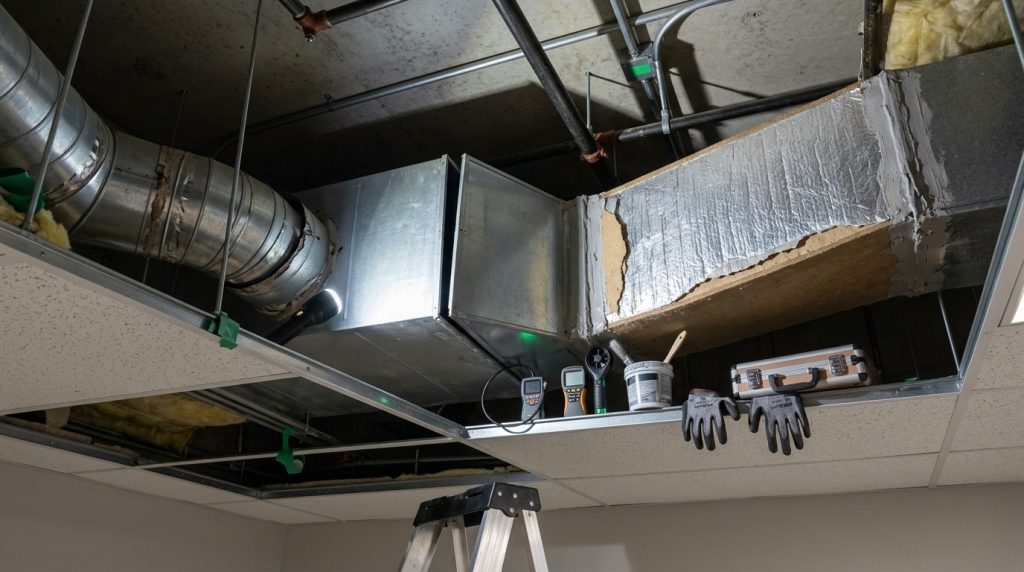
“The failure I see most in pre-2000 office buildings is at the plenum joints, not the registers. The call comes in because a zone is underperforming — one section runs warm while the rest is fine — and the manager assumes it’s the equipment. Nine times out of ten I’m pulling ceiling tiles and finding a separated sheet metal plenum joint.
What most facilities directors don’t realize about fiberboard: it doesn’t fail visibly from outside. Inside, the foil face has started to delaminate — sometimes across several feet — releasing fiber particulate every cycle. That repair is completely different from a separated sheet metal seam: delaminated fiberboard gets sectioned out and replaced, because mastic over a delaminated interior won’t hold under commercial static pressure. Spiral duct fails at collar and coupling connections, not the seam — a different tool set and access plan entirely.
I walk the full run before scoping — one failure at a plenum joint can mask a second further down the same trunk, and if it’s missed you’re back in the ceiling in six months. And the scheduling matters as much as the repair: a restaurant can’t be down for lunch, a medical suite can’t have trades in during patient hours. I coordinate the access window — evenings, weekends, whatever the facility requires.”
Ori Tarzi
Founder, Green Air Duct Club
Built Into The Scope

Repairs Scheduled Around Your Operating Hours

The repair scope and the access window are planned together from the beginning. If a retail property along Loop 1604 needs ceiling-tile access restored before the store opens at 9 a.m., that constraint is built into the job plan before work starts. Business continuity — completing the repair in a way that keeps the tenant’s operations running — drives every scheduling decision. 24/7 availability means exactly that: if your building’s hours require a 10 p.m. start, that’s when the crew shows up.

Matched to the Material

Our Standards for Commercial Ductwork Repair

Every commercial repair is matched to the specific duct material in that building.

Sheet Metal Plenums

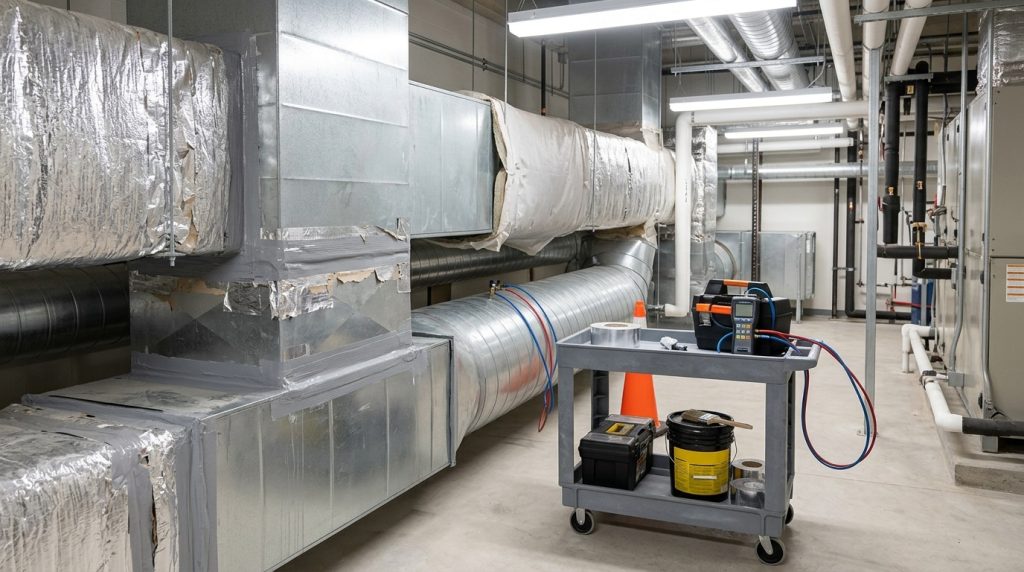
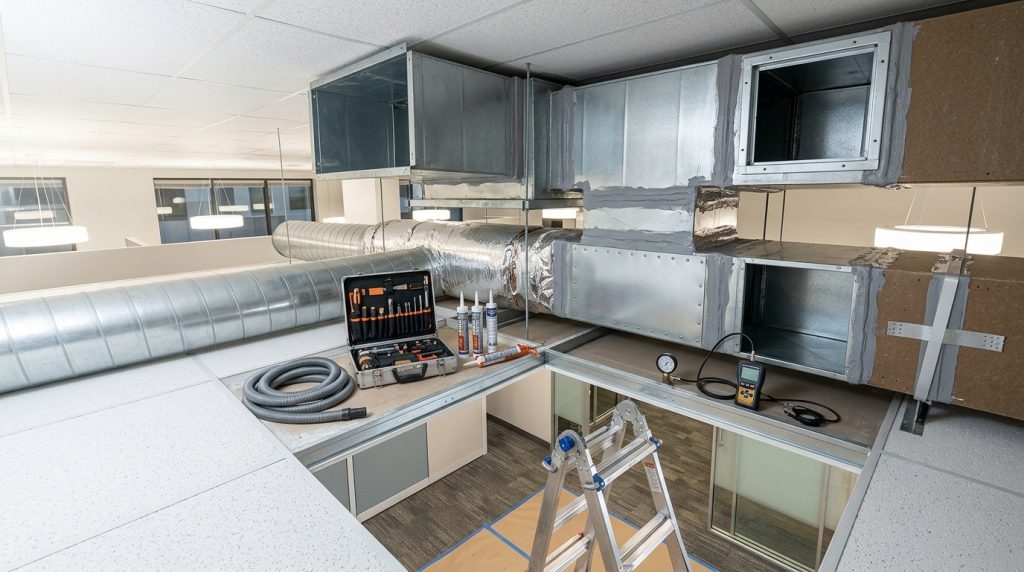
Joint separations re-sealed with commercial-rated brush-applied mastic, plus metal tape where the joint configuration requires it.

Fiberboard Duct Board

Delaminated sections identified, isolated, and replaced — mastic used only on intact fiberboard with no interior foil compromise.

Spiral Duct

Collar and coupling replacements at damaged connection points, with mechanical reconnection confirmed before access panels are closed.

Mastic Over Foil Tape

Foil tape doesn’t hold at commercial static-pressure differentials — mastic is the primary sealant on every commercial seam.

Zone Verification

After repair, airflow to the affected zone is confirmed before the access point is closed, and access is restored to original condition.

The Sequence

How Commercial Air Duct Repair Works

Diagnose the material and location, repair to the material, verify the zone.
01

Diagnostics

We identify which material has failed and where it sits in the distribution path. Ceiling tiles or panels are opened at the supply trunk serving the affected zone, and the full run is walked before scoping — fiberboard checked for foil delamination, sheet metal for joint separation, spiral for collar and coupling failures. Zone failure is frequently traced to a single upstream point; locating it is the priority.
02

Implementation

Method follows material. Sheet metal joints are re-sealed with mastic to the joint face, metal tape added where geometry requires; fiberboard with confirmed delamination is removed and replaced; spiral coupling failures get collar replacement and mechanical reconnection. Where multiple failures sit on the same trunk, all are addressed in a single visit.
03

Post-Service Testing

Airflow to the affected zone is checked for restored conditioned-air delivery. Access panels and ceiling tiles are returned to pre-work condition, and property management is notified when the zone is confirmed operational and the space is ready for occupant access.
Where We Work

Commercial Duct Repair Across the San Antonio Metro

We work office parks, medical suites, restaurants, and retail properties throughout Bexar County — along Loop 410, US-281, and Loop 1604, and in the Pearl District, Southtown, and the Medical Center corridor. After-hours and weekend scheduling is coordinated directly with property management at every location.
Commercial Properties Across Bexar County
Available 24/7

Ready to Schedule Commercial Duct Repair in San Antonio?

Describe the zone failure and the facility type, and we’ll identify the access window that works for your operations and scope the repair to the duct material in your building. Serving San Antonio’s commercial properties since 2009 — 4.8★ across 283 Google reviews. Around your schedule — evenings and weekends included.
Prefer email? Reach us at gr*****************@***il.com if after-hours contact is easier.
Common Questions

Commercial Air Duct Repair in San Antonio: FAQ

The most frequent failure in buildings built before 2000 is plenum joint separation in sheet metal systems — the continuous thermal cycling of a near-year-round cooling season works the connections loose over time. Fiberboard interior foil delamination is the second most common, particularly along the US-281 and Loop 410 corridors in 1970s and 1980s buildings.
Yes. We schedule repairs around your operating hours as a standard part of every job scope. Restaurants, medical suites, and retail properties all have specific access constraints, and those are built into the work plan before the crew arrives. Evening and weekend start times are available across the metro.
Fiberboard with confirmed interior foil delamination is sectioned out and replaced — not resealed — because mastic over a delaminated interior doesn’t hold under commercial static pressure. Sheet metal joint separations are resealed with mastic and metal tape where the geometry requires it. The repair method follows the material, not a single standard approach.
It depends on the number of failure points, the material involved, and access complexity. A single sheet metal plenum joint separation in an accessible ceiling can be resolved in two to three hours; fiberboard section replacement across a longer trunk, or spiral collar replacements with limited ceiling access, take longer. We walk the full run before scoping so estimates reflect the actual condition found.
Yes. After repairs are complete and zone airflow is confirmed, property management receives a summary of what was found, what material was repaired or replaced, and what post-repair airflow verification showed — supporting facility maintenance records and available for any compliance review the property requires.
Office parks, medical suites, restaurants, retail properties, and light industrial facilities throughout Bexar County — along Loop 410, Loop 1604, and US-281, and in the Pearl District, Southtown, and the Medical Center corridor. Facility type and duct material determine how the repair is scoped, not a single standard commercial protocol.