Green Air Duct Club · San Antonio Since 2009

Whole-Home Air Filtration in San Antonio — What MERV Ratings Mean for Your System

A whole-home filtration system — sized and matched to your specific duct system — captures far more airborne particles than a 1-inch filter without straining your air handler.
San Antonio homeowners often jump to higher-MERV filters during cedar season. The instinct makes sense — but a MERV rating too high for your duct system creates a pressure restriction your blower motor was never designed to handle. We evaluate your system’s capacity before recommending any upgrade.
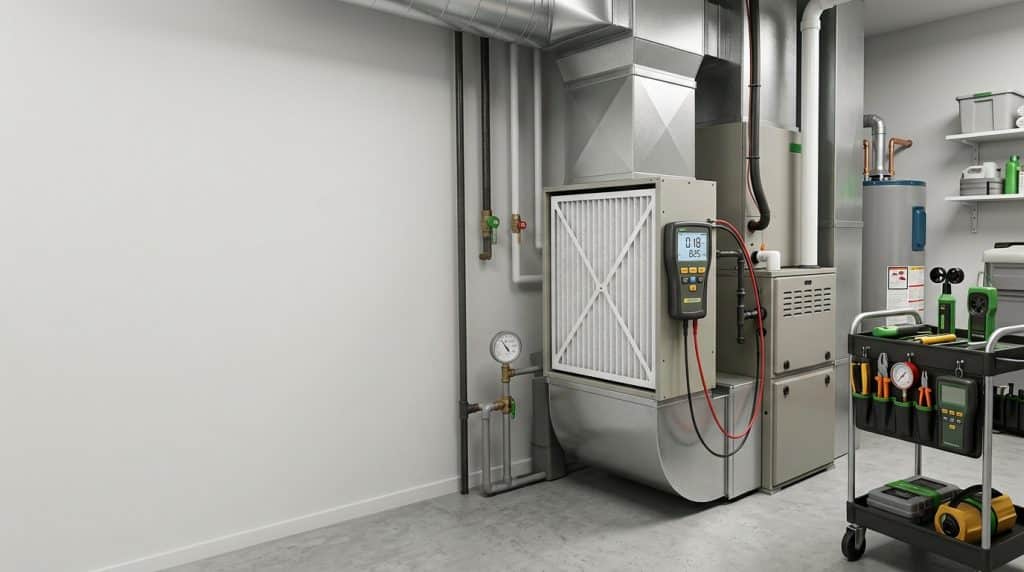
A professional HVAC technician's workshop showing a large residential furnace unit with an attached air filter and digital multimeter for diagnostics. The room features organized shelving with supplies, various testing equipment including pressure gauges, and a mobile tool cart stocked with instruments and safety gear on the right side. Metallic ductwork and piping extend from the ceiling, illustrating a fully equipped service area for heating and cooling system maintenance and repair.
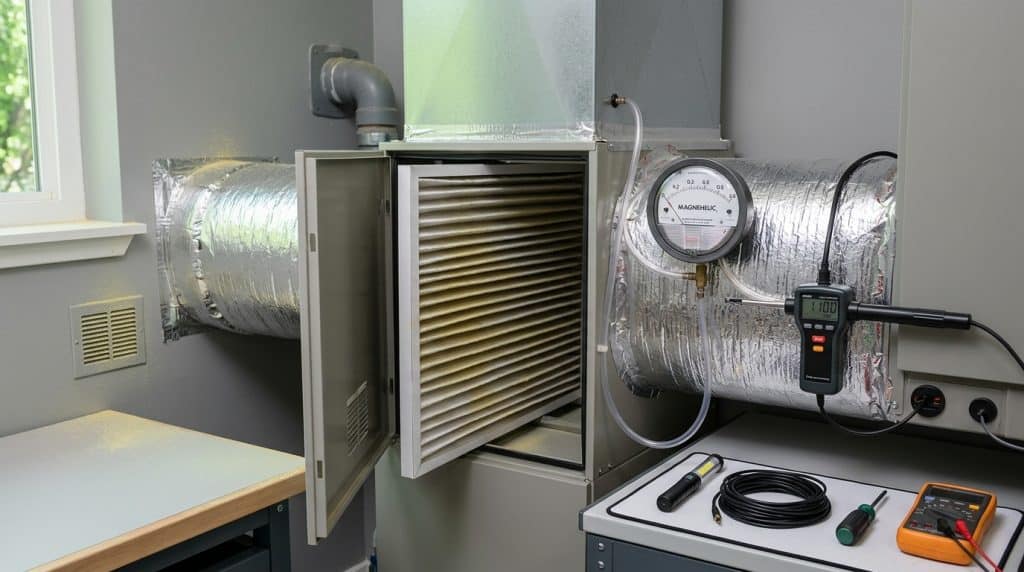
A laboratory setup showing an environmental testing chamber with its door open, revealing horizontal louvered filters inside. Insulated aluminum ducting connects the chamber to measurement instruments mounted on the wall, including a analog pressure gauge and digital monitoring device, while various testing tools and an orange multimeter are arranged on the work surface below.
Cedar Season Reality

Filter Performance During Cedar Season Depends on System Compatibility

San Antonio’s December-through-February cedar event is one of the most intense in the United States.
Ashe juniper along the Hill Country edge — in Helotes and Leon Springs — releases pollen exceeding 15,000 grains per cubic meter at peak. Standard 1-inch filters saturate in days, not the 30-to-90-day interval on the packaging, and a homeowner who doesn’t know is running the system with effectively no filtration. Cedar pollen moves straight through, coats the coil, and deposits in the duct liner.
A purifier sized to what the duct system can actually support stops that cycle before it starts. But the number that captures more pollen also pushes harder against every cubic foot your blower moves — filtration efficiency and airflow pull against each other, and matching them correctly is the work.
From The Field · Ori Tarzi, Founder

The Filter That Was Hurting the System It Was Supposed to Help
“A homeowner in a northwest cedar-belt neighborhood had upgraded to a MERV 13 filter the previous fall because her family struggled with cedar fever. It made sense — it would have made sense to me too, if I hadn’t seen what that choice does inside an undersized return air system.
The air handler was running continuously; supply vents pushed noticeably less air. She thought the system was failing. It wasn’t. The MERV 13 filter — in a return path sized for MERV 8 — had raised the static pressure drop across the filter face enough to run the blower hot, and one coil corner was already frosting from the reduced airflow. I measured static pressure with and without the filter to confirm it.
We installed a 5-inch media air cleaner in the return path — MERV 11 capture, but the resistance is distributed across a much larger filter face, so the pressure drop stays in range. The air handler ran normally within an hour, and the filtration was actually better than the MERV 13 — because it wasn’t choking the system. What does the system support? That answer determines everything.”
Ori Tarzi
Founder, Green Air Duct Club
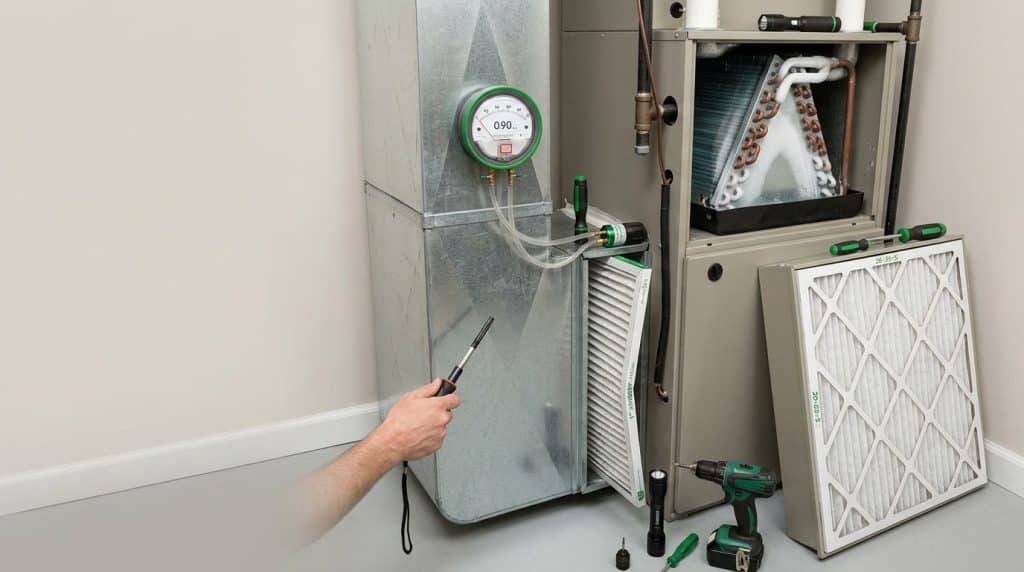
A technician holds a digital thermometer probe while performing HVAC maintenance on residential heating and cooling equipment. The setup includes a furnace unit with a pressure gauge reading 0.90, exposed ductwork, air filters, and various tools including a cordless drill positioned on the floor. The work appears to be part of a routine inspection or service call in a home's mechanical room.
Measure First

Choosing the Right System Starts With What Your Duct System Can Handle

A filtration recommendation that doesn’t start with a static pressure measurement is a guess. Air handler motor strain doesn’t announce itself until the damage is done — elevated temperatures and shortened service life follow, usually before the homeowner connects them to the filter choice. We evaluate three things before any recommendation: the air handler’s design operating range, the existing return air path dimensions, and the current static pressure drop across the existing filter. That tells us exactly how much resistance the system can absorb — and we match the hardware to what the data shows.

Three System Types

Three Filtration System Types and What Each Requires

Media air cleaners, HEPA bypass configurations, and electronic air cleaners solve the same problem through different mechanisms — each with distinct requirements.

Media Air Cleaner

A 4-to-6-inch pleated housing in the return path capturing at MERV 11–13 with a lower pressure drop than a 1-inch filter at the same rating — the most direct upgrade for most cedar-exposed San Antonio homes.

HEPA Bypass System

Diverts part of the airstream through a true HEPA filter and returns it to the supply plenum — for ultrafine particle capture where the duct system can’t support a full-system HEPA pressure drop.

Electronic Air Cleaner

An electrostatic device that charges particles and captures them on collector plates — no high-MERV pressure penalty, but the plates need periodic cleaning to hold efficiency. We explain that clearly first.

Data-Driven Install

How We Install a Whole-Home Air Filtration System

Every installation follows a static pressure assessment first — hardware is selected on what the data shows, not before.
01

Static Pressure Diagnostics

We measure static pressure across your existing filter and at key points in the return path, establishing the baseline — how much resistance the air handler already works against and how much more it can absorb before strain. We review the air handler’s design specs and confirm the return path dimensions before specifying any hardware.
02

Hardware Selection & Installation

Selection follows the data. We size the housing, media depth, and configuration — media air cleaner, HEPA bypass, or electronic air cleaner — to your confirmed capacity, then modify the return path to accept it, seal all contact points against bypass, and verify consistent filter face velocity across the media. Correct sizing, no bypass gaps, even airflow — every time.
03

Post-Installation Verification

We measure static pressure again with the new system in place and compare it to the baseline — improved filtration capacity with pressure drop within the design range, not above it. We confirm the motor is running within normal parameters before closing. You see the before-and-after numbers.
Where We Install

Whole-Home Filtration Across the San Antonio Metro

We work cedar-belt communities in the northwest — Helotes, Leon Springs, and the Hill Country edge — where seasonal pollen puts the most consistent pressure on residential filtration, and homes throughout urban San Antonio where construction dust and traffic particulate drive year-round demand. We also service systems installed by other contractors — a static pressure measurement tells you if yours is running in range.
Cedar Belt & Urban San Antonio
Available 24/7

Match the Right Filtration System to Your Home

Start with a system evaluation — we measure before we recommend anything. Let us know your home size, your current filter type, and when cedar season hits hardest for your family, and we’ll take it from there. Available 24/7 across the metro.
Prefer email? Reach us at gr*****************@***il.com. Available 24/7 across the metro.
Common Questions

Whole-Home Air Filtration in San Antonio: FAQ

Most residential air handlers here are designed for filters rated MERV 8 or below. A MERV 11 or 13 filter in a standard 1-inch return slot raises static pressure beyond what the blower is built to sustain. A 4-to-6-inch media air cleaner can achieve MERV 11–13 capture without the same penalty, because the larger filter face distributes resistance across more surface area. We measure static pressure before recommending any rating.
A properly sized system significantly reduces indoor cedar pollen concentrations during the December-through-February season, but it doesn’t eliminate outdoor exposure. What it does is stop pollen from cycling through your HVAC repeatedly and depositing on the coil and duct liner — the recirculation that keeps indoor levels elevated even after the outdoor count drops. Reducing that is where it makes the most difference.
Under normal conditions, a 4-to-6-inch media filter lasts 9 to 12 months. During cedar season, loading accelerates significantly near the Hill Country edge in areas like Helotes and Leon Springs — we recommend inspecting at the start of February regardless of installation date. A saturated filter during peak weeks provides no more protection than an empty housing.
Yes, but the configuration changes. An undersized return limits what can be installed in-line without airflow restriction. In those cases a HEPA bypass — which diverts part of the airstream through a high-efficiency filter rather than routing the full volume through it — is often the right solution. We assess return path dimensions during the evaluation and specify accordingly.
A media air cleaner is passive: air passes through a dense pleated filter that traps particles, and it’s replaced when saturated. An electronic air cleaner uses electrostatic charge to attract particles to collector plates, which require periodic cleaning to maintain efficiency — if plates aren’t cleaned, performance drops substantially. The right choice depends on your static pressure tolerance and how consistently maintenance will get done.
Yes. We perform static pressure diagnostics, filter replacements, and electronic air cleaner plate cleaning on systems installed by other contractors. If you’re unsure whether your existing system runs within your air handler’s design range, a static pressure measurement will tell you. We serve homes across Bexar County, including 78023, 78254, 78249, and throughout the 78200s.