Green Air Duct Club · San Antonio Since 2009

Replace Your Air Ducts in San Antonio — When Repair Isn’t Enough

When a duct system has passed its design life, individual repairs restore isolated sections — not overall performance.
Air duct replacement means removing the existing flex duct network completely and installing a new system sized to your home’s actual cooling demands. We do this across Bexar County — and we explain exactly which conditions crossed the line from repairable to not worth repairing before any work begins.
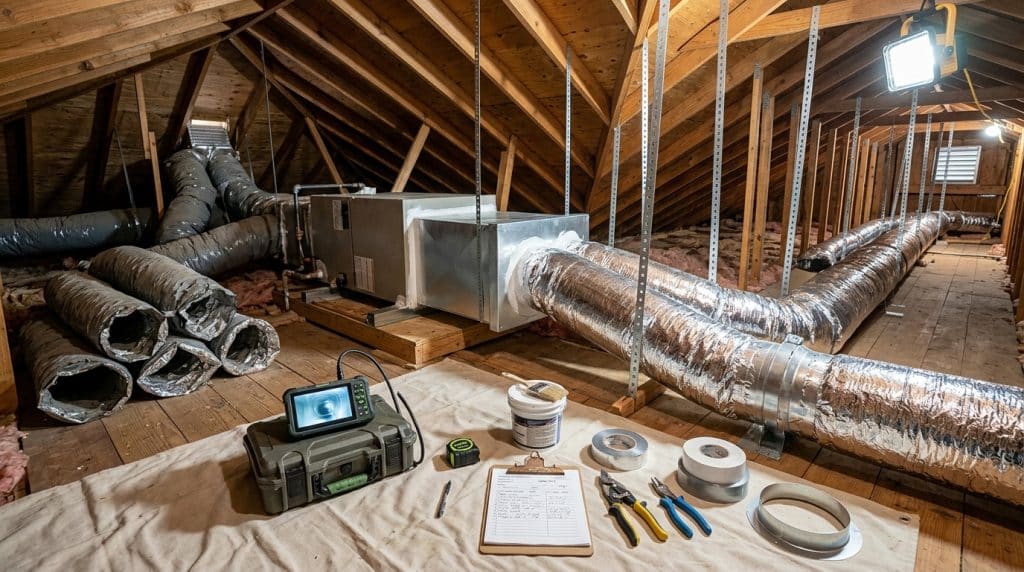
An attic inspection workstation displays professional diagnostic equipment including a thermal imaging camera, clipboard with inspection notes, and various tools and supplies on a white cloth, surrounded by HVAC ductwork, insulation materials, and wooden structural framing in a residential attic space.
When Repair Stops Making Sense

Full Duct Replacement Solves What Spot Repairs Cannot

Duct system lifespan — the expected serviceable life of a flex duct installation — is typically 15 to 20 years. That’s the window manufacturers design for under normal operating conditions. San Antonio is not a normal operating environment: attics that run the better part of the year and push past 140°F in summer age a duct system faster than any lifespan estimate assumes.
An attic space shows HVAC ductwork installation in progress, with insulated aluminum ducts running across wooden joists and fiberglass insulation visible on the floor. On the right side, coils of wire are stacked and organized, along with tools including a multimeter and power drill. A work light illuminates the cramped space where ventilation system components are being installed or inspected.
A Predictable Window

San Antonio’s Housing Stock Creates a Predictable Replacement Window

A home built between 1970 and 1995 in San Antonio is almost certainly running on its original flex duct system.
That puts the system at 30 to 50 years old — well past its design life. The inner liner stiffens and cracks along flex points. The R-6 insulation wrap loses its rated value as the outer jacket separates and thins. In an attic that regularly exceeds 140°F, that degradation accelerates. The system delivers a little less every year, and the utility bill climbs a little more every summer.
Neighborhoods like Alamo Heights, Beacon Hill, and the Near West Side were built primarily before 1975. Helotes and Stone Oak filled out through the 1990s and early 2000s. Each construction era carries predictable duct conditions — and predictable replacement timelines.
From The Field · Ori Tarzi, Founder

What I Found in a Stone Oak Home Built in 1992

“A homeowner in Stone Oak had the system patched twice in three years — a joint re-sealed here, a section of liner replaced there. Two rooms still never cooled right in July, and the upstairs felt like a different climate from the downstairs.
In the attic I understood why the patches hadn’t held. The entire network was original to 1992 — just over 30 years old. The liner had cracked along the flex points nearest the air handler, and the insulation wrap had separated in several sections, leaving bare duct in an attic running above 145°F that day. I could feel conditioned air pushing through joint failures a foot from the duct.
Every repair fixed one point on a network where the underlying material had exceeded its service life across the full run. She asked me to put that in writing before we talked cost — so I did. The reasoning came first, the price second. The replacement took two days: new flex duct with proper R-6 coverage and a resized plenum. Both problem rooms cooled evenly that same week.”
Ori Tarzi
Founder, Green Air Duct Club
An attic workspace showing HVAC installation in progress, with insulated ductwork wrapped in silver foil running along wooden floor joists, a central air handling unit with vertical support poles, coiled flexible ducts, and various tools and equipment organized on a wooden platform, all framed by the exposed wooden roof trusses and insulation above.
No Guesswork

We Document the Reason Before We Quote the Work

Every replacement recommendation comes with a plain-language explanation of why repair is no longer the right answer.

We Document Four Things Before Quoting

If your system is 18 years old with one failed joint and solid material everywhere else, repair is the right call — and we’ll repair it. If it’s 28 years old with widespread mastic failure, degraded insulation, and a leakage rate above 20%, the math points the other way. We’ll show you that math before you decide anything.

How We Install

Our Replacement Standards

Every replacement is installed to current Texas Energy Code standards for Climate Zone 2 — including R-6 insulation coverage on all new flex duct runs.

Manual D Duct Sizing

Every run is sized to the room it serves using Manual D calculation — the engineering method for sizing duct to a home’s floor plan and HVAC capacity — not copied from the old layout.

R-6 Insulation Wrap

All new flex duct gets R-6 insulation, required for new installations in Texas Climate Zone 2. Pre-2000 San Antonio homes frequently have R-4 or degraded insulation on the original runs.

Plenum Replacement or Rebuild

When the central distribution box is undersized or deteriorated, it’s replaced alongside the duct network. A new system connected to an undersized plenum never performs to its potential.

Mastic-Sealed Connections

Every connection is sealed with mastic — not foil tape alone — producing a durable, airtight seal that holds under San Antonio’s thermal cycling.

Air Handler Compatibility

Replacement ductwork is sized to match the air handler’s airflow capacity so the new system performs at the equipment’s rated output.

Start To Finish

How a Duct Replacement Project Works

A full replacement typically takes one to two days, from attic access to airflow confirmation.
01

Diagnostics

Before any duct is removed, we assess the full system — a visual inspection of every accessible run, a duct leakage measurement, and confirmation of air handler capacity. This produces the written replacement rationale, which you review before work begins.
02

Implementation

Existing duct is removed from the air handler outward. We don’t duplicate a flawed layout — over-long runs, excessive bends, or undersized branches get corrected. New flex duct goes in with continuous R-6 coverage, proper support to prevent sagging, and mastic-sealed connections. The return path is sized to match the supply.
03

Post-Service Testing

We confirm airflow at every supply register, check that no register is delivering far more or less than its neighbors, and verify the new system measures well below 10% leakage under standard conditions.
Where We Work

Duct Replacements Across Bexar County

Green Air Duct Club completes full duct replacement projects across San Antonio’s established and growing neighborhoods — Alamo Heights, Helotes, Stone Oak, Lackland AFB-area homes, Beacon Hill, Leon Valley, and the wider metro. Scheduling is available seven days a week around your calendar. If your neighborhood isn’t listed, call — we cover the full Bexar County service area.
Bexar County & Surrounding Communities
Available 24/7

Know Whether Replacement Makes Sense for Your Home

The first step is a clear finding — not a quote. We’ll assess your existing duct system, document what we find, and explain in plain terms whether the conditions point toward repair or replacement. If replacement is the answer, you’ll understand exactly why before any work begins.
Prefer email? Reach us at gr*****************@***il.com. Available 24/7 across the metro.
Common Questions

Air Duct Replacement in San Antonio: FAQ

The threshold comes down to system age, leakage rate, and how widespread the damage is. When a flex duct system is over 25 years old, has a measured leakage rate above 20%, and shows degraded insulation wrap across multiple runs, repair costs on individual sections tend to approach full replacement cost without delivering the same outcome. We document these conditions in writing so you’re not making that call based on a technician’s word alone.
Most single-story homes in the 1,500 to 2,500 square foot range take one full day. Two-story homes or complex attic layouts — common in older Alamo Heights and Beacon Hill properties — typically take two days. We confirm the expected timeline during the diagnostic step before work begins.
In homes with high duct leakage rates, yes — measurably. A system losing 25% or more of conditioned air through duct failures forces your AC to work significantly harder to reach setpoint. Reducing that leakage to below 10% on a new installation typically means lower runtime and lower monthly consumption. The exact reduction depends on square footage, existing equipment efficiency, and how severe the current leakage is.
We evaluate the plenum — the central distribution box at the air handler — as part of every replacement assessment. If it’s undersized for the current air handler, deteriorated, or poorly sealed, we replace or rebuild it alongside the new duct network. Installing new runs on a failing plenum limits the performance of the whole system.
All new flex duct installations use R-6 insulation wrap, the minimum required under the Texas Energy Code for Climate Zone 2. Many pre-2000 San Antonio homes have original R-4 insulation that has also degraded over decades. The upgrade to R-6 meaningfully reduces heat gain in attics that regularly exceed 140°F through the summer.
We complete replacement section by section with planned shutdowns during each phase. Most homeowners are without cooling only for short windows during the workday rather than the full project. We schedule around household needs — especially important during San Antonio’s summer — and confirm the daily sequence with you before starting.