Green Air Duct Club · Resource · San Antonio

Why Your San Antonio Home Smells Musty When the AC Runs — and How to Fix It

A musty smell from air vents in San Antonio is almost always biological growth — and it has a precise location inside your system.
You notice it in the first few seconds. The AC kicks on, a wave of stale, damp air comes through the vents, then it fades as the air circulates — strongest in the rooms closest to your air handler. It isn’t seasonal. It has a source, and there are four places that source lives: the evaporator coil, the drain pan, the blower wheel, or the duct liner. We identify it first, then tell you exactly what work addresses it.
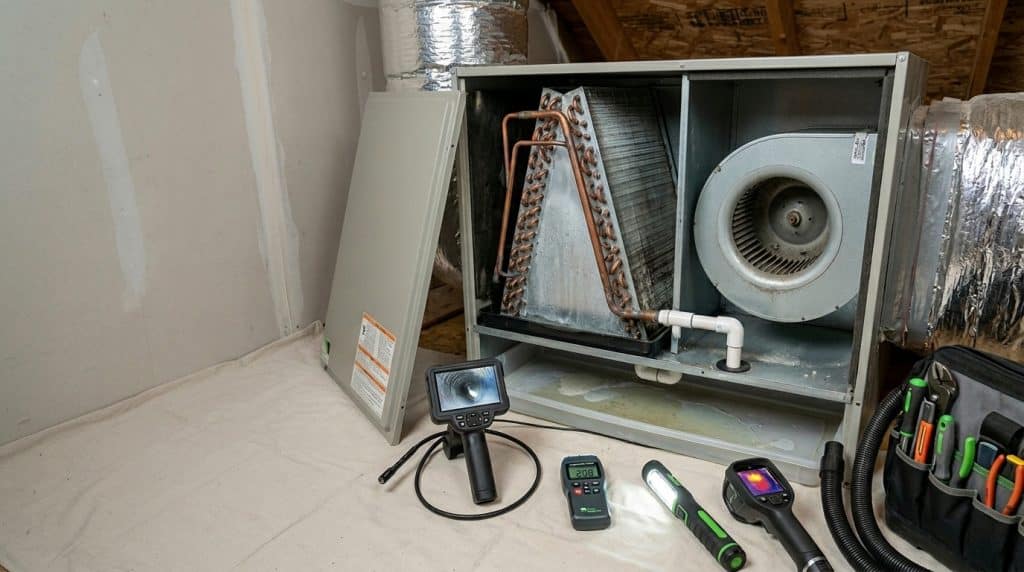
A technician's workstation showing an open HVAC unit with internal components including copper coils and a centrifugal fan, accompanied by diagnostic tools such as an inspection camera, multimeter, thermal imaging camera, and a flashlight arranged on a white surface in front of the unit.
It Has A Source

That Musty Odor When Your AC Turns On Has a Specific Source

The odor is strongest in the first few seconds after startup and fades as air circulates — a signature of contamination somewhere between the air handler and the register. Four components produce it: the evaporator coil, the condensate drain pan, the blower wheel, and the duct liner. Each produces a recognizable odor, each has a specific fix, and none of them resolve on their own. Green Air Duct Club has diagnosed HVAC odor complaints in San Antonio homes since 2009 — we find the source before we recommend anything.
Why It Happens Here

San Antonio’s Humidity Creates the Right Conditions for This Problem

Summer dew points above 65°F keep evaporator coils wet between cycles — the core condition that drives musty HVAC odors. Your system doesn’t just cool the air; it pulls moisture out of it, and that moisture collects on the coil and drips into the drain pan below. When the AC cycles off, the coil stays wet, and in a warm, dark cabinet that wet surface becomes a growth environment. One wet season rarely produces a noticeable smell — two or three seasons of uninterrupted growth is when homeowners start searching for answers.
We serve homes from the Medina River corridor in the southwest, where outdoor humidity runs persistently high, to newer builds in the northeast where oversized systems short-cycle and leave coils wetter than they should be. Both produce the same complaint — the fix depends on where the growth has taken hold.

The Full Map

Each Source Has a Direct Fix

Coil, drain pan, blower wheel, and duct liner each produce a musty odor through a different mechanism — and each has a specific fix.

Evaporator Coil Growth

Mold, bacteria, and biofilm on the wet indoor coil — the most common primary source, producing the sharpest odor at startup when airflow first crosses the surface. Fix: AC coil cleaning, with UV light installation to interrupt regrowth.

Drain Pan Contamination

Biological buildup in the condensate pan beneath the coil — a secondary source that keeps producing odor even after a coil cleaning. Fix: drain pan cleaning as part of AC cleaning, plus UV light if algae is persistent.

Blower Wheel Biofilm

Growth on the fan blades launches odor-laden particles into the supply stream with every revolution, spreading the smell evenly across every room rather than concentrating it. Fix: blower wheel cleaning as part of a full AC cleaning service.

Duct Liner Contamination

Biological matter inside the flex duct liner, active once coil growth has persisted across seasons and spores migrate downstream. Fix: professional duct cleaning of affected runs, with IAQ symptom mapping used to confirm which runs are involved before cleaning begins.

Look Before Recommending

How We Confirm the Source Before Any Work Begins

Some odor calls are simple; some involve two active sources at once. The only way to know which services are actually needed is to look first. When we arrive, we open the air handler and evaluate coil surface condition, drain pan accumulation, and blower wheel appearance directly — plus filter condition and a humidity reading at the return side. If the coil and pan are clean and the smell persists, we look closer at the nearest duct runs. You’ll know what we found and what it points to before we quote anything. If it’s the drain pan and not the coil, we’ll say so; if it’s the blower wheel, that’s a different, lower-cost service than a full duct cleaning. IAQ symptom mapping isn’t an extra step — it’s the only way to make sure the work you pay for actually resolves the smell.
Four Variables

What Shapes the Outcome in a San Antonio Home

Four things determine whether a musty odor resolves completely or returns within a season — two are specific to San Antonio’s climate.
01

How Long Growth Has Been Active

A coil cycling wet through one summer looks different from one building biofilm for three or four seasons. More established growth requires more thorough cleaning and is likelier to have migrated downstream into the duct system.
02

System Sizing & Cycle Behavior

An oversized AC that short-cycles doesn’t run long enough to dehumidify, so the coil stays wetter between cycles. Oversized new construction is a documented condition in newer San Antonio subdivisions — humidity control depends on run time.
03

Whether a UV Light Is in Place

Without a germicidal lamp at the coil, biological regrowth begins within weeks of a cleaning in San Antonio’s summer humidity. UV light installation interrupts that cycle at the source.
04

How Many Duct Runs Are Affected

One contaminated run near the air handler is a different scope than whole-home liner contamination. IAQ symptom mapping at diagnosis determines which runs need cleaning — avoiding both under-service and unnecessary work.
Where We Serve

Musty AC Odor Diagnosis Across the San Antonio Metro

We diagnose and fix musty HVAC odors across the full metro, 24/7 — Helotes, Stone Oak, Alamo Heights, Leon Valley, Converse, Schertz, the South Side, the West Side, and communities throughout Bexar County. If your AC has a smell you haven’t been able to resolve, we’re available to schedule any time.
Bexar County & Surrounding Communities
Available 24/7

The Smell Has a Source — Let’s Find It

A musty smell from your vents doesn’t go away on its own — the source stays active until it’s specifically addressed. Tell us when the smell is strongest, which rooms it hits, and how long it’s been there, and we’ll schedule the diagnostic visit and tell you exactly what we find before any work begins.
Prefer email? Reach us at gr*****************@***il.com. Available 24/7 across the metro.